United States Celebrates 250 Years Of Independence Amid Severe Storms And Deep Political Divisions
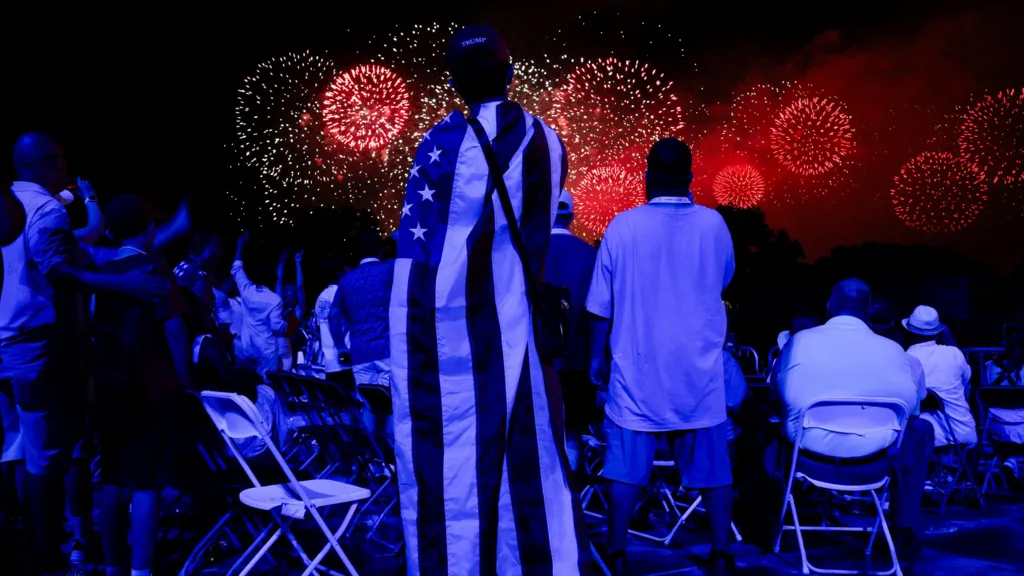
Image: GhanaFront Editorial
A Historic Milestone Overshadowed By Nature and Politics
The United States of America has marked a monumental chapter in its history, commemorating exactly 250 years of independence from British colonial rule. However, the historic Semiquincentennial celebrations on July 4 were heavily characterized by a combination of intense political polarization and devastating weather patterns that swept across the vast continent. From the grand, meticulously choreographed flyovers in Washington D.C. to widespread, paralyzing power outages across the American Midwest, the nation's 250th birthday offered a vivid and sobering snapshot of a global superpower grappling with both internal societal divisions and severe natural disruptions.
The Fourth of July federal holiday is a cornerstone of American national identity, commemorating the decisive moment in 1776 when thirteen distinct colonies officially adopted the Declaration of Independence. This daring rejection of the British Empire set the stage for the creation of the modern United States. Yet, a quarter of a millennium later, the anniversary arrived at a moment when the fundamental ideals outlined in that founding document are the subject of fierce domestic debate.
The Climate Disruption and Infrastructure Failures
While millions of citizens prepared to celebrate the historic anniversary, a sweeping, unrelenting heatwave and a series of severe thunderstorms violently interrupted the national festivities. In the capital city of Washington, a massive thunderstorm forced an abrupt early evening evacuation of the National Mall, temporarily halting the highly anticipated, government-sponsored national program and sending thousands of spectators scrambling for shelter.
The catastrophic weather impacts extended far beyond the federal capital. Extreme atmospheric conditions unleashed punishing winds exceeding 97 kilometres per hour (60 mph) in the state of Michigan. Energy provider DTE reported that these ferocious gales compromised power grids, leaving more than 350,000 households in total darkness on Friday evening. Further east, utility tracker data from Power Outage confirmed that at least 150,000 homes in New Jersey also suffered complete electrical blackouts.
The trail of infrastructural disruption was massive, extending across several key states, including Pennsylvania, Illinois, Ohio, New York, and Wisconsin. The persistent heatwave, coupled with sudden violent storms, served as a stark reminder of the escalating climate challenges and the vulnerability of regional power infrastructure facing the North American continent, even on its most heavily celebrated national holiday.
Presidential Rhetoric and "Freedom 250"
Against the backdrop of nature's unpredictable fury, the political atmosphere in the United States was equally turbulent. The country remains sharply divided along partisan lines, a reality that was highly visible throughout the anniversary events. US President Donald Trump utilized the 250-year milestone to project his specific political agenda, launching his distinct "Freedom 250" celebrations. This initiative operated entirely separate from the "America 250" events that had been previously established by the US Congress, drawing significant criticism from political opponents who accused the president of attempting to monopolize a unifying national milestone for explicit partisan gain and self-promotion.
Following the weather delays in Washington, Trump addressed a massive, cheering crowd on the National Mall just before the stroke of midnight. His expansive address heavily emphasized his administration's recurring themes. He explicitly rejected what he termed as creeping communism, advocated strongly for the "Save America Act" legislation he favors, and vigorously defended the constitutional right to bear arms under the Second Amendment.
"The American dream is back. This is only the dawn of the golden age of America, with its destiny written by God." -- US President Donald Trump
The "Freedom 250" event ultimately concluded with a spectacular fireworks display -- widely reputed to be the largest and most expensive in the nation's history -- and a grand aerial flyover that prominently featured the newly commissioned Air Force One jet. Yet, the triumphant celebratory optics and military displays could not mask the stark ideological divide that currently defines the modern American political landscape.
Reflections From Former Leaders
The stark contrast in national vision was most evident in the public statements released by the four living former US presidents. Their individual messages noticeably diverged from the celebratory triumphalism of the current administration, focusing instead on the historical fragility of democracy and the ongoing, often painful struggles for social equality within the republic.
- Joe Biden: The immediate past president focused his message on the founding edict that all people are created equal. He reminded citizens that choosing the path of independence 250 years ago was merely the beginning of the work, warning that the fundamental promise of equality remains an ongoing and unfinished project. "We chose that path 250 years ago but that's where the work began, not where it ended," he noted.
- Barack Obama: The nation's first black president echoed a similar sentiment, sharing poignant excerpts from a recent address delivered at his presidential museum's opening. He emphasized the generational responsibility to protect what is right and fix what is wrong, urging Americans to constantly strive toward making the union "a little more perfect." He stressed that every generation must take up the unfinished work of the last.
- George W. Bush: The 43rd president issued a direct call to civic duty. He stated that the next two and a half centuries will require Americans to be active citizens, not mere spectators. He insisted that the populace must take an active interest in the health and welfare of their country and the local communities in which they reside.
- Bill Clinton: Providing perhaps the most sobering assessment of the day, the 42nd president highlighted the acute existential challenges facing the country today. He openly acknowledged that the monumental milestone arrives amid another period of deep division, renewed questions regarding the global role of the US, and profound threats directed at the very heart of American democratic institutions.
A Nation at a Crossroads
As the smoke from the unprecedented fireworks displays clears across the American skies, the United States finds itself at a profound and highly scrutinized historical juncture. The 250th anniversary of the break from British rule was intended to be a moment of absolute, unifying national pride. Instead, it has vividly showcased the dual realities of the contemporary American state. On one hand, there is a display of unparalleled military and economic might, symbolized by the elite aerial flyovers and the sheer financial scale of the celebrations. On the other hand, there is undeniable vulnerability -- both to the increasingly erratic forces of nature that disabled critical infrastructure across multiple states, and to the deep-seated ideological rifts that threaten the foundational cohesion of the republic.
For international observers, particularly those assessing global democratic trends, the American Semiquincentennial offers a compelling lesson in the complexities of sustained nation-building. The endurance of the American democratic experiment over two and a half centuries is undoubtedly a monumental and historic achievement. However, as the contrasting presidential messages clearly indicate, maintaining that democratic system requires constant, unwavering vigilance. The United States steps into its next 250 years not necessarily in the undisputed dawn of a golden age, but rather in the complex trenches of an ongoing ideological battle to define exactly what the fundamental American promise truly means for its diverse citizenry in the 21st century.
More from GhanaFront Editorial
Related Stories
More from Politics
Baffour Awuah's arrest is a political witch-hunt - Kofi Bentil
Was the MP's arrest justice or a political vendetta? Two legal minds disagree - find out why.
1d ago•2 min read