McDan pushes Ghana to shield local businesses from pressure
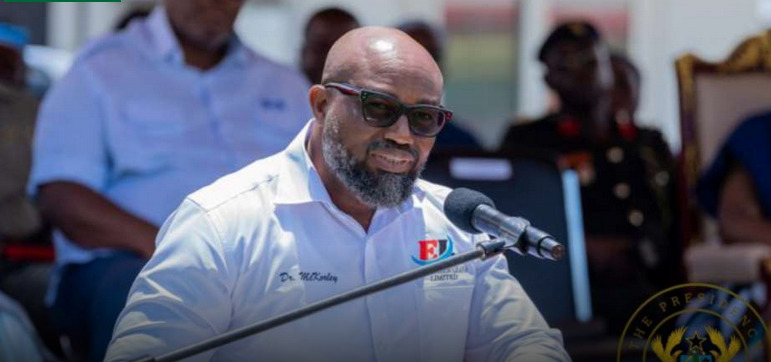
Image: GhanaFront Editorial
Calls for stronger protection of Ghanaian businesses are no longer coming from the margins. They are now being made from the centre of corporate Ghana, with direct warnings that the country’s economic future will suffer if local enterprises are left vulnerable while competing interests tighten their grip on key sectors.
That message came sharply into focus in Accra when Executive Chairman of the McDan Group, Daniel McKorley, used the launch of the 10th Ghana CEO Summit to press for firmer state action in support of indigenous enterprise. His argument was blunt: if Ghana is serious about economic transformation, then the private sector cannot be treated as an afterthought.
For him, the issue is not symbolic patriotism or policy slogans. It is about whether Ghanaian businesses that commit capital, employ workers and build local capacity are given the backing needed to compete and survive.
Private sector seen as the engine of transformation
McKorley framed the debate around a familiar but unresolved national question -- who will drive Ghana’s next phase of growth? His answer was clear. He said the country’s economic transformation will depend heavily on a strong private sector that is able to invest, innovate and create jobs at scale.
That position carries weight because it touches the central tension in Ghana’s development model. Governments routinely announce plans for industrial growth, entrepreneurship and local participation in the economy. Yet business leaders often argue that practical support does not always match the public language.
At the summit launch, McKorley urged the state to move beyond speeches about indigenisation and adopt measures that offer real protection to Ghanaian enterprises. In his view, local businesses are being asked to shoulder major risks without enough policy backing.
“Various governments should walk the talk of indigenization, and it shouldn’t just be rhetoric,” he said. “We need, government needs, to protect the private sector against foreign invasion.”
The phrase he used was striking, and it reflected a deep frustration that some local business leaders have expressed for years. The concern is that Ghanaian firms in important sectors can be weakened when foreign competition grows in an environment where domestic operators do not enjoy equivalent structural support.
His intervention therefore goes beyond one company or one sector. It is a broader call for economic policy that treats Ghanaian ownership and local business growth as strategic national priorities.
Why business leaders say protection matters
McKorley described local firms as the country’s risk-takers, making the case that they deserve protection because they are the ones putting money on the line in uncertain conditions. That point speaks to the everyday reality of many Ghanaian businesses facing high operating costs, financing constraints and intense competition.
“We are the risk-takers of the country, and we must be protected.”
The argument is simple enough. If domestic companies are expected to lead expansion, hire workers and build wealth within Ghana, then the policy environment must not leave them exposed. A weak private sector cannot anchor a strong economy. And if local businesses are unable to grow sustainably, then the knock-on effects will be felt across employment, tax revenue and broader economic resilience.
His call also revives an old debate about what protection should actually mean. It does not automatically suggest shutting out foreign participation. Rather, it raises questions about whether procurement, incentives, regulation and access to opportunity are being designed in ways that genuinely strengthen Ghanaian firms.
In practical terms, a stronger protective framework for local enterprise could involve:
- clearer enforcement of local participation rules where they already exist
- policy consistency that gives Ghanaian investors confidence to plan long term
- targeted support for sectors where local businesses can scale quickly
- fair competition rules that prevent indigenous firms from being crowded out
- improved access to conditions that allow local companies to invest and innovate
McKorley’s comments suggest that without this kind of deliberate support, the language of economic self-determination will remain hollow.
Jobs, graduates and the urgency of private sector growth
The most immediate national pressure point tied to this discussion is unemployment, especially among young people leaving tertiary institutions each year. McKorley connected the fortunes of the private sector directly to that challenge, arguing that business leaders must be able to absorb large numbers of job seekers entering the market annually.
“We have to make sure that we, as captains of industry, be able to absorb the 500,000 unemployed men coming out of the universities year by year,” he said.
The figure he cited underlines the scale of the problem as he sees it. Whether framed as unemployment or underemployment, the pressure created by a steady flow of graduates is one of the most difficult economic and social tests facing the country. It is also where rhetoric is least useful. Graduates need jobs, not speeches. Businesses need room to expand, not applause.
That is why his remarks matter beyond the summit stage. They place responsibility on both the state and the private sector. Government, in his telling, must build the environment. Business must deliver the investment and jobs.
He made that division of roles explicit.
“The government creates the normal environment, but it is business that invest, innovate, and create jobs,” he said.
This is one of the clearest summaries of the development bargain being proposed by many business leaders in Ghana today. The state should provide stability, policy support and protection. The private sector should respond by expanding production, creating employment and helping carry the economy forward.
It is a demanding formula because each side can only do its part properly if the other does not fail. Businesses cannot absorb growing numbers of job seekers if the operating climate remains punishing. Government cannot expect employment gains if domestic enterprise is not positioned to grow.
That makes the conversation about protection more than a business lobby request. It becomes a national economic question with consequences for household livelihoods, youth opportunity and the country’s longer-term competitiveness.
From summit rhetoric to policy action
The 10th Ghana CEO Summit launch offered the right platform for such a message because it brought together attention, influence and urgency. But the real test begins after the speeches end.
McKorley’s intervention challenges policymakers to define what support for indigenous business truly looks like in practice. If indigenisation is national policy language, then local firms will expect to see it reflected in decisions that shape market access, investment confidence and the security of domestic enterprise.
His warning is worth taking seriously because it links three issues that cannot be separated: business protection, economic transformation and job creation. Weakness in one quickly damages the others.
- Without protection, local firms face greater vulnerability.
- Without strong local firms, investment and innovation suffer.
- Without investment and innovation, job creation slows.
- Without jobs, unemployment pressures deepen, especially for graduates.
That chain is not theoretical. It is visible in the pressure many households and businesses already feel. Ghana’s path to durable growth will depend not just on macroeconomic recovery, but on whether its own enterprises are strong enough to help power that recovery from within.
McKorley’s remarks were therefore not simply a defence of business interests. They were a demand for economic seriousness. Ghanaian businesses, he argued, are not asking for empty praise. They are asking for the protection required to do what the country repeatedly says it wants them to do -- invest, innovate and create jobs.
If that protection remains rhetorical, then the cost will not be borne by boardrooms alone. It will be paid in lost jobs, weaker local industry and a slower national transformation. That is the stakes of the argument now on the table.
More from GhanaFront Editorial
Related Stories
More from Technology

NCA awards 700MHz spectrum to MTN Ghana for US$109.9m
MTN outbids rivals for key spectrum, but what happens next in the 5G race?
1d ago•2 min read