Ghana's Flooding Crisis: Moving Beyond the Blame Game to Real Urban Resilience
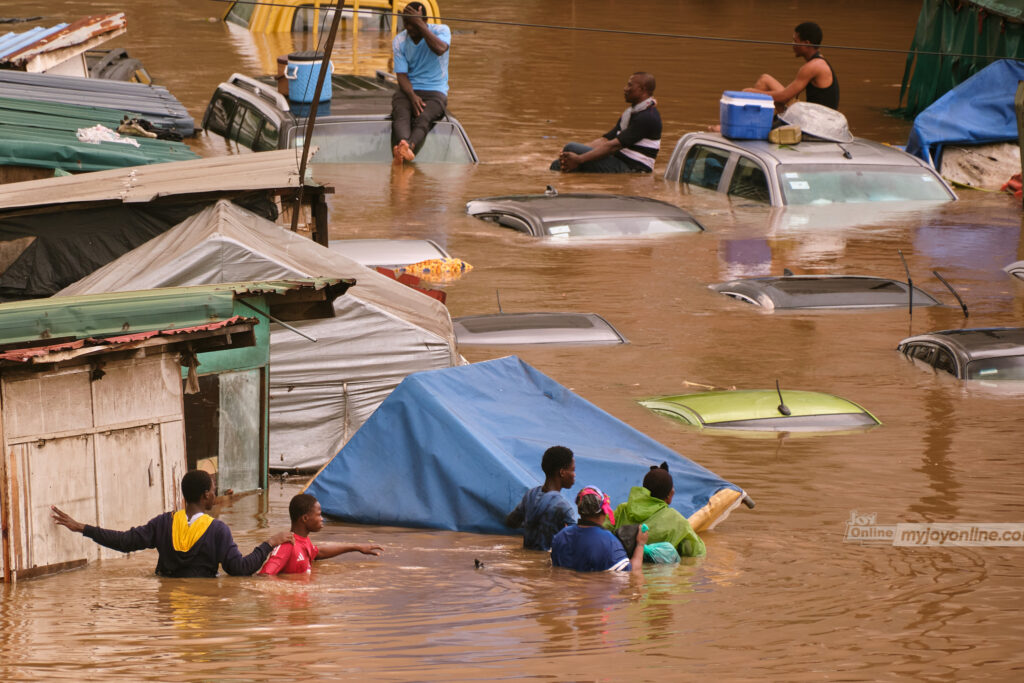
Image: GhanaFront Editorial
Accra's Flooding Crisis: A Disaster of Human Design
Every year, as the rainy season approaches, residents of Accra brace themselves for the inevitable. The skies open, the streets transform into rivers, and the nation witnesses a familiar cycle of destruction, followed by promises from officials that fade as quickly as the floodwaters. However, the recurring devastation in areas like Kwame Nkrumah Circle, Odawna, Adabraka, and the Tema motorway is not a natural inevitability. Accra is drowning by design.
Recent research analyzing flood incidence and rainfall data in the capital reveals a stark reality: there is no statistical correlation between increased rainfall intensity and the rising frequency of floods. A mere 25 millimetres of rain is now enough to overwhelm the city. The primary culprit is a systemic failure in land use and urban planning.
The history of Ghana's flooding dates back decades, with records indicating severe disruptions as early as 1959 when 7.56 inches of rain brought Accra to a standstill. In 1968, another deluge paralyzed the city, leading to closed businesses and abandoned classrooms. The late 1990s and early 2000s saw recurring nightmares, with the 1999 floods displacing nearly 300,000 people across five regions. By 2010, the death toll from a single month reached 35, compounded by the spillage of Burkina Faso's Bagre Dam which displaced over 161,000 citizens nationwide. Most recently, the devastating events of March and September 2023, the May 2025 fatalities, and the June 2026 submergence of critical infrastructure serve as grim reminders of a worsening crisis. These are not isolated incidents; they form a long, painful legacy of institutional neglect and societal complacency.
The Five Pillars of Our Vulnerability
The structural conditions that led to the tragic June 3, 2015 disaster -- which claimed approximately 150 lives and caused an estimated $50 million in property damage -- remain largely unaddressed. The persistent failure to manage flood risks rests on five main pillars:
- Rampant Encroachment on Waterways: A 2026 analysis by the Greater Accra Resilient and Integrated Development (GARID) project exposed that 16% of the legally designated 25-metre drainage buffer zones across Greater Accra have been lost to illegal structures. In sampled areas alone, 10,497 structures sit precariously within these buffers.
- Institutional Fragmentation: Responsibility for flood control is scattered across multiple agencies, with administrative boundaries failing to align with natural drainage basins, making cohesive planning nearly impossible.
- Funding and Political Roadblocks: The $350 million World Bank-funded GARID project, designed to be Ghana's ultimate flood solution, was downgraded to "Moderately Unsatisfactory" in May 2026. This was caused by the Ministry of Finance capping disbursements and sweeping GH₵13.8 million from the project's account, leaving critical contractors unpaid.
- Weak Enforcement: Over 52% of households in flood-prone areas cite poor enforcement of land regulations as the main cause of flooding. Vital wetlands like the Densu Delta, Sakumo Lagoon, and Songor Lagoon continue to face relentless encroachment.
- Disrupted Natural Balance: Rampant concreting and solid waste blocking drainage channels mean the city's natural ability to absorb water has been severely compromised.
"When we have the volume of rain that we do, the water doesn't have a natural path. That will inevitably impact people." -- Kojo Ohene Safo, GARID Project Coordinator
Global Blueprints for Urban Resilience
While Ghana struggles to break this cycle, other nations have successfully transitioned from vulnerability to resilience. Their strategies offer actionable roadmaps for Accra.
In the Netherlands, a country where a third of the land is below sea level, the government shifted from simply building higher walls to giving rivers room to flow. Their 2.3 billion Euro "Room for the River" programme relocated dikes and restored floodplains, dramatically lowering design water levels while creating beautiful public spaces.
Japan, facing intense rainfall, innovated with "Tambo Dams" -- utilizing ordinary rice fields to temporarily store excess stormwater. This watershed-based approach effectively controls river flow without compromising agricultural productivity.
In Singapore, where land is scarce, infrastructure serves multiple purposes. The nation has invested heavily in parks that double as retention basins and waterways that serve as recreational spaces, all monitored by a network of over 300 early warning sensors.
Meanwhile, China's "Sponge City" initiative relies on nature-based solutions like permeable surfaces and urban wetlands to absorb rainwater natively. In Germany, structured collaboration between local authorities has eliminated the institutional silos that plague Ghana's efforts, ensuring that upstream and downstream communities share the responsibility of flood management.
The GARID Project: A Stalled Lifeline
The GARID project represents the most significant investment in Ghana's history toward solving the flooding crisis. Tasked with reducing flood risks, upgrading drainage systems, and strengthening emergency responses, the initiative has made tangible progress. Between 2025 and 2026, the project spent $13.52 million, successfully dredging 90,936 cubic metres of sediment from the Odaw Channel. Major drainage works in Alogboshie, Akweteyman, and Nima are well over the halfway mark.
The stalling of this critical project is particularly disheartening. When the World Bank downgraded the project's performance rating, it wasn't due to insurmountable engineering challenges or a lack of initial capital. Instead, it was a direct consequence of internal fiscal mismanagement. The Ministry of Finance's decision to cap disbursements and divert funds effectively paralyzed contractors who were already deployed on the ground. This kind of political interference transforms a funded, actionable solution into an unfinished construction site that paradoxically worsens flooding when incomplete trenches and unlined channels are exposed to heavy downpours.
"Drainage works are costly, but failing to fund them is a political failure. More resources must be made available to protect lives and property." -- Ing. Wise Ametefe
Empowering Communities at the Grassroots
While large-scale engineering projects are vital, the power of grassroots interventions cannot be overstated. Across the African continent, communities are demonstrating that proactive local action saves lives. In Dalafilani, Guinea, residents banded together to construct a localized network of canals specifically designed to rapidly evacuate floodwaters from their neighborhoods.
Similarly, in Kenya's Ewaso Nyiro basin, local communities leveraged indigenous knowledge to form task forces that successfully managed water flows during peak rainfall. Even as far away as Colombia, community action boards have proactively created risk maps and installed grassroots early warning systems. These examples prove a crucial point: solutions do not always have to be handed down from central governments. When Ghanaian communities are respected as active stakeholders and provided with basic technical guidance and tools, they possess the inherent capacity to protect their own neighborhoods and drastically reduce the impact of sudden cloudbursts.
Charting a Flood-Free Future
To end the annual ritual of displacement and death, Ghana must fundamentally rethink its approach to urban governance. First, land governance must become the non-negotiable foundation of flood management. Digital land use mapping using GIS technology must be employed to gazette all flood-risk zones, with absolute zero tolerance for encroachment. Planners and local authorities must be held legally accountable when building permits are illegally issued in these red zones.
Furthermore, nature-based solutions such as permeable paving and restored riparian buffers must be integrated into all new infrastructure. We must also overcome institutional fragmentation by establishing a unified collaborative structure across all agencies responsible for water and urban planning, eliminating the fragmented approach that currently paralyzes decisive action.
The catastrophic floods of June 2026 were not unavoidable acts of nature; they were the direct consequences of human actions, systemic neglect, and political failure. With $350 million dedicated to the GARID project, Ghana possesses the financial resources to implement lasting change. What is urgently required now is the collective political and social will to respect the rules, hold leaders accountable, and prioritize the common good over individual convenience. It is time to build a nation that does not just brace for the rains in fear, but thrives resiliently alongside them.
More from GhanaFront Editorial
Related Stories
More from Politics

The Reciprocity crisis: Why Ghana welcomes British Professionals while the UK relegates ours
Why does Britain embrace our professionals while sidelining theirs here? The answer may reshape migration debates.
4d ago•