Ghana’s Export Diversification Drive Delivers .28 Billion Breakthrough
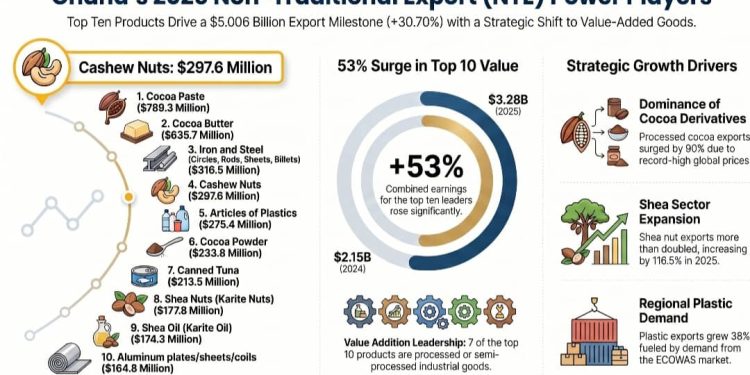
Image: GhanaFront Editorial
Ghana’s non-traditional export drive delivered one of its clearest signals yet in 2025, with the country’s 10 leading products in the category generating a combined $3.28 billion. Fresh figures from the Ghana Export Promotion Authority show the top tier of the sector did far more than post higher numbers. It reinforced a bigger shift in the economy -- from reliance on raw commodity shipments to stronger earnings from processed, value-added goods.
The latest performance represents a 53 percent rise from the $2.15 billion recorded in 2024. Just 10 products accounted for 65.48 percent of all non-traditional export revenue, with each product contributing an average of $327.86 million. That level of concentration shows where Ghana’s export momentum is strongest, and it also highlights the industries now carrying the country’s diversification agenda.
Ghana’s top 10 non-traditional export products generated $3.28 billion in 2025, up from $2.15 billion in 2024, according to GEPA.
Processed cocoa takes centre stage
The standout story in the 2025 rankings came from cocoa processing. Ghana has long been identified globally with cocoa bean production, but the latest export results point to a more profitable direction. Processed cocoa products now sit at the core of the country’s non-traditional export surge, with cocoa paste, cocoa butter and cocoa powder all posting major gains.
Cocoa paste emerged as the highest-earning product in the group, bringing in $789.3 million. That was a 70.97 percent increase over the previous year and a strong signal that global demand for semi-processed cocoa ingredients remains robust. Cocoa butter recorded the sharpest rise among the leading products, climbing 120.18 percent to $635.7 million. Cocoa powder also expanded rapidly, jumping 112.97 percent to $233.8 million.
Those three products tell a simple but important story. Ghana earns more when it processes more. Instead of depending only on raw bean exports, the country is increasingly securing higher returns from ingredients used by food manufacturers, beverage producers and cosmetics brands around the world. That is not a cosmetic change in trade composition. It is industrial policy showing up in export receipts.
Industry analysts linked the gains to rising global appetite for cocoa-based inputs used across confectionery, drinks and premium cosmetic products. For Ghana, the implication is clear. The value chain matters. The more the country deepens processing capacity at home, the stronger its position becomes in international markets that reward finished and semi-finished inputs over raw material shipments.
Shea, cashew and factory output deepen the export base
The export expansion was not limited to cocoa. Shea products delivered another strong vote of confidence in Ghana’s agricultural processing potential, especially from the north. Shea nuts, also known as karite nuts, generated $177.8 million after rising by 116.51 percent. Shea oil added $174.3 million, marking a 15.43 percent increase.
These gains reflect growing international demand for natural ingredients used in cosmetics, pharmaceuticals and personal care products. Ghana’s shea sector has for years been described as an underused national asset. The 2025 numbers suggest that argument is losing relevance. Shea is no longer just a promising story. It is already producing serious export value.
Cashew nuts also remained a dependable pillar in the non-traditional export basket. The product earned $297.6 million, up 10.15 percent from the previous year. The growth rate was more moderate than the leap seen in cocoa and shea, but the result still matters. In a volatile international market, consistency has value. Cashew’s continued contribution points to Ghana’s reliability as a supplier and its ability to retain market confidence even when conditions are uneven.
Manufacturing and fisheries also made meaningful gains, showing that export growth is spreading across sectors rather than resting on a single commodity cluster.
- Articles of plastics generated $275.4 million, up 37.85 percent.
- Canned tuna reached $213.5 million after a 37.34 percent increase.
- Aluminium plates, sheets and coils earned $164.8 million, rising 50.48 percent.
The plastics numbers indicate that industrial production can play a larger role in Ghana’s export future if firms are supported to scale. The rise in canned tuna exports shows the country continues to benefit from demand for processed seafood, while aluminium products gained from stronger external demand linked to construction activity in global markets.
Together, these results matter because they broaden the story. Ghana’s export diversification effort is strongest when more sectors are involved. Cocoa may be leading the charge, but sustained resilience will depend on building multiple export engines across agriculture, industry and processing.
One weak spot does not change the bigger direction
Not every major product posted gains. Iron and steel products, including rods and billets, slipped by 1.59 percent to $316.5 million. GEPA attributed the decline to fluctuating global prices and stronger competition on the international market. The drop was mild, but it serves as a reminder that export performance remains tied to global conditions that local producers cannot fully control.
Still, the broader pattern in the report is hard to ignore. Ghana is gradually reducing its exposure to the old trap of exporting mainly unprocessed raw materials while importing value-added goods at a premium. The strongest performers in the 2025 rankings were precisely the products that benefited from some level of domestic transformation before shipment.
That shift is economically significant. Raw commodity dependence exposes countries to price swings they do not control. Value-added production offers better margins, stronger industrial linkages and more room for jobs, skills development and technology transfer. Ghana’s latest export data suggests that this logic is moving from policy language into measurable output.
The top 10 products accounted for 65.48 percent of total non-traditional export earnings in 2025, averaging $327.86 million each.
The challenge now is not proving that the diversification strategy can work. The numbers have already done that. The real question is whether the country can sustain and scale the momentum. That will depend on continued investment in processing capacity, export financing, logistics, quality standards and market access. It will also require policy stability. Export sectors do not grow on speeches. They grow on dependable systems.
For now, the 2025 GEPA report offers a strong marker of progress. Cocoa processing has surged, shea products have expanded sharply, cashew remains steady, and manufacturing segments are gaining ground. The picture is not flawless, but it is compelling. Ghana’s non-traditional export sector is no longer a side conversation in the economy. It is becoming one of the clearest proofs that diversification, when backed by productive capacity, can deliver real money and real momentum.
The $3.28 billion performance by the top 10 products is more than a record. It is evidence that Ghana’s exporters are finding stronger footing in markets that reward processing, consistency and quality. That matters for trade, for industry and for the country’s economic future. The task ahead is to turn this breakout year into a durable pattern.
More from GhanaFront Editorial
Related Stories
More from Technology

YEA partners Ghana Digital Centre to train 2,000 young people in IT
A new partnership aims to equip 2,000 youth with tech skills - but what exactly will they learn?
6d ago•1 min read