Mary Addah Defends OSP Independence in Ghana's Anti-Graft Fight
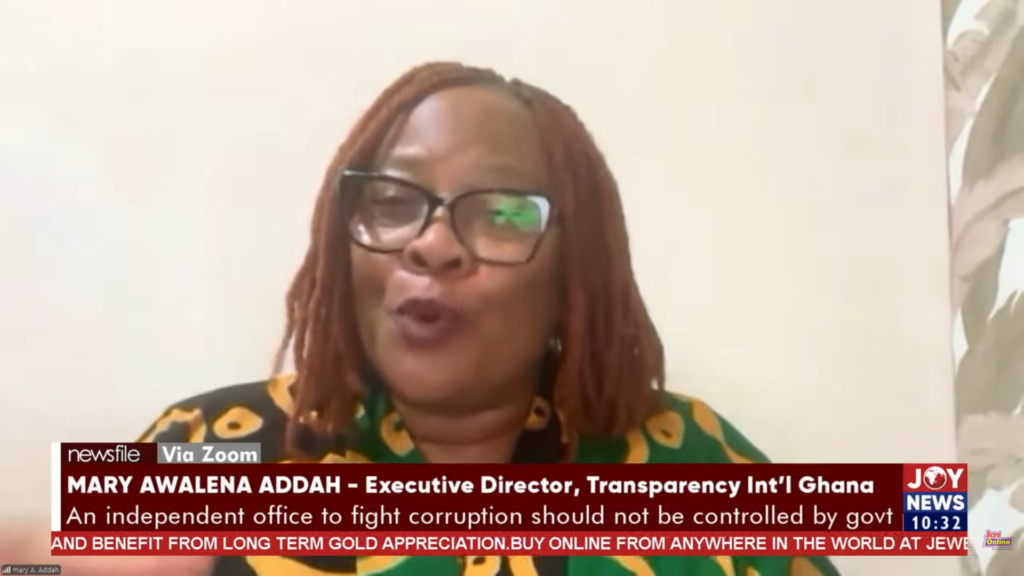
Image: GhanaFront Editorial
Calls for stronger anti-corruption enforcement in Ghana have returned to the centre of public debate, with Transparency International Ghana insisting that any office charged with investigating and prosecuting graft must be protected from political control.
Mary Awalena Addah, Executive Director of Transparency International Ghana, argued that the country’s anti-corruption architecture will remain vulnerable if institutions designed to check abuse of office continue to depend on the executive branch for their strength and survival. Speaking on JoyNews' Newsfile programme on Saturday, she said the credibility of the anti-corruption fight depends on whether institutions can act without fear, favour or political interference.
"Its independence is crucial; if it remains under executive control, its mandate is compromised, and it cannot fulfil its role effectively," Mary Awalena Addah said.
Why the independence debate has returned
Addah said civil society groups have long argued that Ghana would be better served by an anti-corruption arrangement that clearly separates investigative work from prosecutorial authority. According to her, advocacy backed by research had already pointed in that direction, but constitutional barriers prevented that vision from being fully implemented.
That limitation, she explained, shaped the structure that eventually emerged. Early proposals developed under the National Anti-Corruption Action Plan framework had aimed at creating a truly independent prosecutorial office. What Ghana ultimately got was the Office of the Special Prosecutor, established under a model that did not fully match civil society’s preferred design.
Even so, Addah said civil society actors chose to engage with the process rather than walk away from it. Their goal, she noted, was to help ensure that the Office of the Special Prosecutor became a credible national tool in the campaign against corruption, even if the final institution fell short of the original ambition.
Her intervention comes at a time when questions about institutional independence continue to shape public conversations about accountability, misuse of public funds, procurement violations and the broader ability of the state to sanction wrongdoing among public office holders.
OSP figures strengthen the case for autonomy
Addah backed her argument with performance figures from the Office of the Special Prosecutor, pointing to what she described as concrete evidence that the institution can produce results when given space to operate.
In its first fully operational year, the office increased its caseload from 27 matters to 167. It also recovered GH₵35 million and prevented potential losses of more than GH₵7.18 billion. Those numbers, she suggested, show that the institution is not merely symbolic. It has already demonstrated capacity in investigation, asset recovery and preventive intervention.
For many governance observers, those figures matter because anti-corruption institutions in Ghana are often judged not just by legal mandates but by visible outcomes. Recoveries, prevented losses and the number of active cases offer a measurable basis for assessing whether an office is functioning as intended.
Addah maintained that these gains should not be dismissed simply because the institution is not perfect. In her view, the Office of the Special Prosecutor has already shown that it can help hold public officials accountable. The larger danger, she warned, is allowing politics to erode its authority before it reaches full institutional maturity.
- Caseload expanded from 27 to 167 cases
- GH₵35 million recovered
- More than GH₵7.18 billion in potential losses prevented
Those outcomes, she argued, reinforce the case for strengthening independence rather than weakening it.
Public trust remains a major signal
Addah also cited public opinion data that suggests many Ghanaians share that position. According to the figures she referenced, 77.7% of surveyed citizens believe an independent anti-corruption office should not be under government control. Another 55.2% identified the Office of the Special Prosecutor as the most trusted institution to investigate and prosecute corruption.
That level of confidence is significant in a political environment where public trust in state institutions is often contested. For anti-corruption bodies especially, legitimacy is not built only through law. It is also sustained by the belief that cases will be pursued fairly, without partisan calculation and without selective silence when politically powerful figures are involved.
Addah’s position is that executive influence weakens precisely that confidence. Once the public believes an institution can be steered, stalled or intimidated by the government of the day, its deterrent effect drops sharply. In practical terms, that means corrupt conduct becomes harder to confront because the institution tasked with acting may itself be seen as constrained.
She said the fight against corruption cannot be reduced to public rhetoric or periodic headline cases. It requires stable institutions that can investigate wrongdoing, prosecute offenders, monitor procurement systems and help prevent future abuse. Any attempt to reduce the operational freedom of such an office, she stressed, amounts to an attack on accountability itself.
Political interference remains a live concern
Addah did not limit her criticism to one administration. She said both previous and current governments have, at different points, taken steps that sought to limit the influence of the Office of the Special Prosecutor. According to her, these efforts have come through court challenges and legislative manoeuvres that distract the office from its core work.
That criticism touches a deeper structural problem in Ghana’s governance system. Anti-corruption bodies are often praised in principle, but when their work begins to affect politically exposed persons or uncomfortable state interests, resistance intensifies. The result is a cycle in which reform is announced, institutions are created, but pressure mounts once enforcement becomes real.
Addah’s warning is that this pattern cannot continue if Ghana is serious about confronting corruption beyond campaign slogans. An anti-corruption office that must constantly defend its existence or navigate repeated political obstacles will spend too much energy on survival and too little on enforcement.
She warned that court actions and legislative attempts to curb the office's influence distract it from investigating corruption, monitoring procurement and preventing future abuses.
Her remarks point to a broader question that Ghana will have to answer clearly: should anti-corruption enforcement be designed as an independent national safeguard, or remain vulnerable to the same political forces it is expected to police?
For Addah, the answer is straightforward. Ghana needs institutions that are trusted, effective and free enough to pursue corruption wherever it appears. Anything less leaves the country with an accountability system that looks strong on paper but weakens when pressure rises.
The debate around the Office of the Special Prosecutor is therefore bigger than one office. It is a test of whether the state is prepared to protect institutions that investigate power, not just praise them when convenient. If the office is to continue delivering recoveries, expanding cases and commanding public trust, its independence will remain the defining issue.
That is why Addah’s intervention matters. It places the spotlight back on a hard truth at the centre of Ghana’s governance debate: an anti-corruption body cannot effectively investigate those in power if those in power retain the means to control it.
More from GhanaFront Editorial
Related Stories
More from Technology

NCA awards 700MHz spectrum to MTN Ghana for US$109.9m
MTN outbids rivals for key spectrum, but what happens next in the 5G race?
1d ago•2 min read