Expect Road Diversions: Military Leads Nationwide Flood Recovery Operations Across Ghana
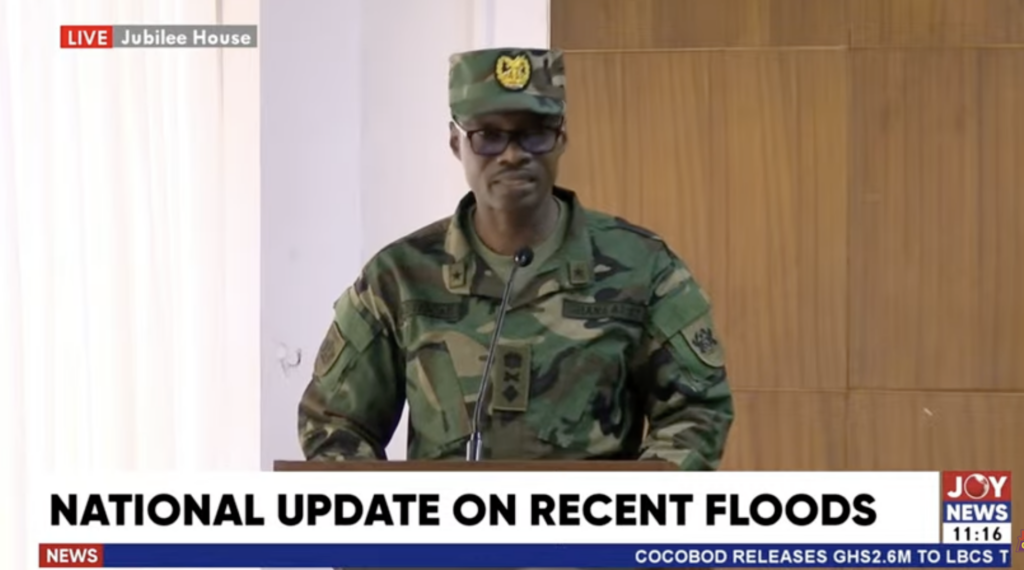
Image: GhanaFront Editorial
Military Leads Intensive Cleanup Campaign Across Affected Regions
Commuters and motorists navigating through flood-affected areas across Ghana have been strongly urged to brace for significant traffic diversions and restricted access to certain key routes. This development comes as the government initiates an intensive, nationwide flood recovery and engineering operation. The comprehensive exercise aims not only to clear massive volumes of flood debris but also to reconstruct damaged drainage infrastructure and fortify local communities against future climatic vulnerabilities.
Brigadier General Forster Okae-Yeboah, the Director General of Joint Operations of the Ghana Armed Forces (GAF), formally issued this advisory during a national press briefing. He stressed that the temporary disruptions, while admittedly inconvenient for daily travel and commerce, are absolutely critical for the successful execution of environmental restoration and civil engineering tasks.
The operation represents a transition into a highly active phase of the government's coordinated response to the recent devastating floods that have swept across various parts of the country. This current phase is characterized by the widespread deployment of heavy machinery, specialized engineering teams, and coordinated security personnel across severely impacted metropolitan and district areas.
"As part of these operations, the public is advised that portions of roads may experience temporary traffic diversions or restricted access while the clean-up and engineering works are underway," stated Brigadier General Okae-Yeboah.
He explained at length that the emergency interventions -- which include extensive debris removal, dredging of choked primary drains, and drainage reconstruction -- are crucial for minimizing the risk of recurrent flooding. The military is working in close, unprecedented collaboration with various other security agencies and local government bodies to ensure a unified and highly effective response on the ground.
MMDAs and Heavy DRIP Equipment Mobilized for Decentralized Action
In a strategic move to ensure rapid and comprehensive coverage across all regions, Metropolitan, Municipal and District Assemblies (MMDAs) have been explicitly mandated to spearhead local clean-up initiatives within their jurisdictions. This decentralized approach is purposefully designed to complement the rigorous efforts of the military and national emergency responders, ensuring that no affected community, regardless of how remote, is left behind during the critical recovery process.
The Director General emphasized that this localized strategy is the master key to accelerating the overall pace of recovery across the nation. By fully empowering MMDAs to take immediate charge of their respective districts, the central government aims to deliver targeted relief and bespoke engineering solutions directly where they are most urgently needed by the populace.
Crucially, the ongoing operation is being heavily supported by state-of-the-art machinery procured under the District Road Improvement Programme (DRIP). A substantial national fleet consisting of excavators, motor graders, payloaders, and other heavy-duty earthmoving equipment has been actively dispatched to facilitate the ongoing works. These machines are currently playing a pivotal role in clearing severely blocked subterranean drains, repairing compromised roadway surfaces, and removing heavy, compacted flood deposits that have continuously hampered free vehicular movement and posed severe public safety risks.
Given the sheer scale and complexity of the engineering interventions required, Brigadier General Okae-Yeboah reiterated that motorists must logically anticipate intermittent road closures. He appealed passionately to all residents, commercial drivers, and private motorists to cooperate fully with traffic management teams and armed security officials stationed on the ground to regulate movement.
"Residents are therefore urged to fully cooperate with personnel on the ground and to comply with all traffic management and safety instructions issued by the security agencies," he urged during his address.
Furthermore, property owners and individuals whose structures currently fall within natural waterways or designated drainage reservations have been asked to collaborate proactively with authorities. This cooperation is vital to allow the seamless execution of this critical national assignment, which often requires the removal of illegal structures to allow water to flow freely. The senior military official assured the general public that all actions taken during this tense period will be conducted with the highest level of professionalism, humanity, and strict adherence to the fundamental tenets of Ghanaian law.
Private Sector Contributions and Sustained Future Resilience
The ambitious recovery and engineering operation has notably drawn significant, tangible support from beyond the public sector. Numerous private organizations and corporate entities have admirably answered the government's call for national assistance by voluntarily supplying essential logistical support, heavy machinery, and specialized technical expertise.
Brigadier General Okae-Yeboah highly commended these corporate entities, noting that their swift contributions reflect a profound sense of patriotism and deep-seated corporate social responsibility. This emerging public-private partnership has drastically boosted the state's logistical capacity to execute extensive, capital-intensive engineering works within a remarkably compressed timeframe.
"The government is particularly grateful to the numerous private sector organisations that have responded positively to the national appeal by voluntarily providing heavy equipment, technical expertise and logistics to support the exercise," he noted with appreciation.
Looking ahead, the current military-led operation is positioned as more than just a reactionary emergency measure. It forms a fundamental, foundational component of a much broader, long-term national flood resilience strategy championed by the state. This overarching comprehensive plan focuses heavily on upgrading the country's aging drainage infrastructure network, tightening the rigorous enforcement of environmental and zoning regulations, and drastically improving early warning mechanisms for vulnerable communities.
To properly sustain these infrastructural gains, authorities are persistently urging all citizens to adopt better, more responsible environmental practices. The public has been strictly advised to immediately desist from the indiscriminate dumping of solid refuse into gutters, proactively keep community drains clear of plastic waste and other obstructions, and swiftly report any damaged bridges or blocked culverts to the relevant local municipal authorities. Adherence to strict health and sanitation directives issued by the Ghana Health Service is also being strongly encouraged to actively prevent post-flood disease outbreaks, such as cholera and typhoid.
As various specialized technical and operational subcommittees plunge deeply into their rigorous field work, Brigadier General Okae-Yeboah issued a firm, unwavering assurance to the President and the Chief of Staff that the assembled task force will leave no stone unturned in executing their mandate. Regular, detailed updates from the Emergency Communications Committee will continue to be broadcasted to keep the Ghanaian public adequately informed about changing traffic arrangements, road closures, and ongoing emergency interventions throughout the full duration of the national exercise.
More from GhanaFront Editorial
Related Stories
More from Politics

John Boadu leads NPP chairmanship race with 48% in Global InfoAnalytics poll
Which candidate is pulling ahead among committed NPP delegates just days before the vote?
1d ago•2 min read