Africa Must Unite to Win the AI Race, Bawumia Tells London Summit

Image: GhanaFront Editorial
Africa stands at a crossroads. The continent that gave the world its first mathematicians, its oldest universities, and some of its most enduring civilisations now faces a defining choice: will it be a passive consumer of artificial intelligence, or will it rise to become a co-author of the technology reshaping the world?
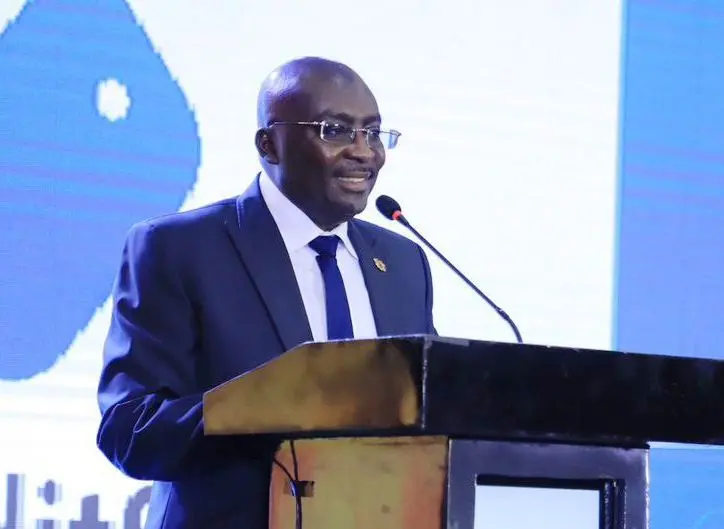
Former Vice President Dr Mahamudu Bawumia made that question the centrepiece of his address at the prestigious LSE Africa Summit 2026, calling on African nations to abandon the habit of working in isolation and embrace a new era of cross-border collaboration in AI and digital innovation.
A Shared Capability, Not a Collection of Imports
Dr Bawumia's central argument was disarmingly straightforward: Africa cannot afford to treat artificial intelligence as something it buys from abroad, configures locally, and hopes works well enough. That model, he warned, leaves the continent permanently dependent on external developers, external servers, and external rule-makers.
"Artificial intelligence can unite borders if Africa builds capability and then connects that capability across borders," he told delegates at the London summit.
The vision he outlined was of a continent that pools its talent, its data, and its infrastructure into something far greater than any single country could build alone -- a continental AI capability stack that positions Africa not merely as a user of the technology, but as a shaper of it.
"If we treat AI as a national and continental capability stack, we can become co-authors of the rules, the markets, and the benefits," he said.
It is a vision that resonates far beyond the political circles from which Bawumia emerges. Technology leaders, development economists, and policy researchers have long argued that fragmented national digital strategies are among the biggest obstacles to Africa's full participation in the global digital economy.
The Infrastructure Gap -- and How to Close It
For any serious discussion of African AI to have practical meaning, it must grapple honestly with infrastructure. And here, the challenges are substantial.
Much of the continent still relies on undersea cable connections that route even intra-African internet traffic through European or American hubs before it arrives at its final destination a few hundred kilometres away. Data centres are clustered in a handful of cities -- Nairobi, Lagos, Johannesburg, Cairo -- leaving large swaths of the continent severely underserved. Cloud services that businesses and developers in Europe or North America take for granted are either unavailable or prohibitively expensive for millions of Africans.
Dr Bawumia's prescription for this is regional cloud infrastructure -- shared systems built and governed collectively by groups of African nations, reducing the dependency on hyperscalers headquartered in Silicon Valley or Frankfurt. Combined with harmonised regulatory frameworks that allow data to flow freely and securely across borders, such infrastructure would provide the foundation on which a genuine continental AI economy could be built.
"Build foundations, govern trust, and then connect markets so African talent and AI solutions can scale across the continent."
-- Dr Mahamudu Bawumia, LSE Africa Summit 2026
The logic is compelling. A healthcare AI model trained exclusively on Ghanaian patient data will perform poorly in Zambia or Senegal. A fraud detection system built for one country's mobile money network may be blind to patterns that emerge only across a larger, more diverse dataset. The quality and applicability of AI systems improve dramatically with scale -- and Africa's scale is enormous, if it chooses to use it collectively.
AfCFTA as the Digital Launchpad
Dr Bawumia pointed to the African Continental Free Trade Area as a critical existing framework for enabling digital interoperability and inclusive growth. The AfCFTA, which came into operation in 2021 and has been progressively implemented since, was conceived primarily as a framework for goods and services. But its architects and advocates have increasingly recognised that its full potential will only be realised if it encompasses the digital economy as well.
Trade in digital services -- software development, data processing, AI applications, financial technology -- is already among the fastest-growing segments of global commerce. African nations that harmonise their digital regulations, recognise each other's data protection frameworks, and allow AI-powered services to cross borders without cumbersome re-licensing requirements will be far better placed to capture that growth than those that cling to purely national approaches.
- Harmonised data protection and privacy laws that enable cross-border data flows
- Mutual recognition of digital signatures and electronic contracts
- Shared frameworks for AI governance, ethics, and accountability
- Collaborative investment in regional cloud and connectivity infrastructure
- Pan-African talent pipelines -- scholarships, fellowships, and exchange programmes in AI and data science
Progress on these fronts has been uneven, but the direction of travel is increasingly clear. The Digital Trade Protocol under the AfCFTA framework, still under negotiation, could prove transformative if it is ambitious enough in scope.
Digital Sovereignty in a World of AI Giants
Beneath the optimism of Dr Bawumia's address runs a harder, more urgent current: the question of sovereignty.
The global AI landscape today is dominated by a small number of very large technology companies, most of them American or Chinese. These companies own the most powerful models, control the most critical infrastructure, and increasingly set the terms on which the rest of the world engages with AI. Governments, businesses, and citizens in most African countries interact with AI systems they did not build, running on hardware they do not own, governed by policies written in foreign capitals.
That is not merely an economic disadvantage. It is a governance vulnerability. AI systems encode values and assumptions. They make decisions about credit worthiness, health risk, criminal likelihood, and educational attainment. When those systems are built and controlled entirely outside the continent, African governments have limited ability to audit them, challenge them, or ensure they reflect local realities and priorities.
Building shared continental capability -- in infrastructure, in talent, in governance -- is therefore not simply about economic competitiveness. It is about ensuring that Africa retains meaningful agency over the systems that will increasingly shape the lives of its people.
Ghana's Position in the Continental Conversation
For Ghana specifically, the speech carries particular resonance. The country has positioned itself as a digital hub for West Africa and beyond, hosting the African Continental Free Trade Area Secretariat in Accra and investing in fibre connectivity, mobile money infrastructure, and digital skills development over the past decade.
Ghana's National Digital Economy Policy and its ambitions around the Ghana.gov unified digital services platform are early examples of what nationally-anchored digital development can look like. But Dr Bawumia's challenge is to think beyond the national frame -- to ask what Ghana contributes to and gains from a genuinely integrated African digital economy.
That question has no easy answers. It requires navigating real tensions between national industrial policy ambitions and continental integration commitments, between protecting domestic data and enabling the cross-border flows that make AI genuinely useful, between building local capacity and attracting the foreign investment that can accelerate it.
Ambition Matched to Action
Dr Bawumia's speech at the LSE was, by the standards of such events, admirably concrete in its prescriptions. Shared infrastructure. Harmonised regulation. Regional cloud systems. Interoperability frameworks built on the AfCFTA architecture. These are real policy levers, not empty rhetoric.
What remains to be demonstrated is the political will to pull them -- in Accra, in Abuja, in Nairobi, in Pretoria, and in the dozens of smaller capitals whose cooperation is essential to making a continental vision real.
The technology itself is not waiting. The models are being trained, the applications are being deployed, the markets are being shaped. Africa's window to become a co-author rather than a consumer of this transformation is real -- but it is not indefinitely open.
As Bawumia put it, the path forward requires building foundations, governing trust, and connecting markets. Each step depends on the ones before it. The question for African leaders, technologists, and citizens alike is whether they are willing to do the patient, collaborative, often unglamorous work of laying those foundations -- together.
More from GhanaFront Editorial
Related Stories
More from Technology
Africa Must Build and Connect Its Own AI Future, Bawumia Tells LSE Summit
Bawumia urges African nations to build shared AI infrastructure and harmonise regulations at the LSE Africa Summit 2026.
4h ago•6 min read
Bawumia at LSE: Africa Must Build AI Together or Fall Behind Alone
Bawumia urges Africa to adopt a cross-border approach to AI, warning that isolated national efforts will leave the conti
22m ago•8 min read
Bawumia Urges Africa to Build a Continental AI Capability Stack, Not Fragmented National Silos
Bawumia calls on African nations to build shared AI infrastructure and regional cloud systems to become co-creators in t
8h ago•6 min read
Africa Cannot Afford to Miss the Fourth Revolution - Bawumia
Bawumia warns Africa cannot afford to miss the fourth revolution- but what's at stake if the continent falls behind?
7h ago•4 min read