Bawumia Urges Africa to Build a Continental AI Capability Stack, Not Fragmented National Silos

Image: GhanaFront Editorial
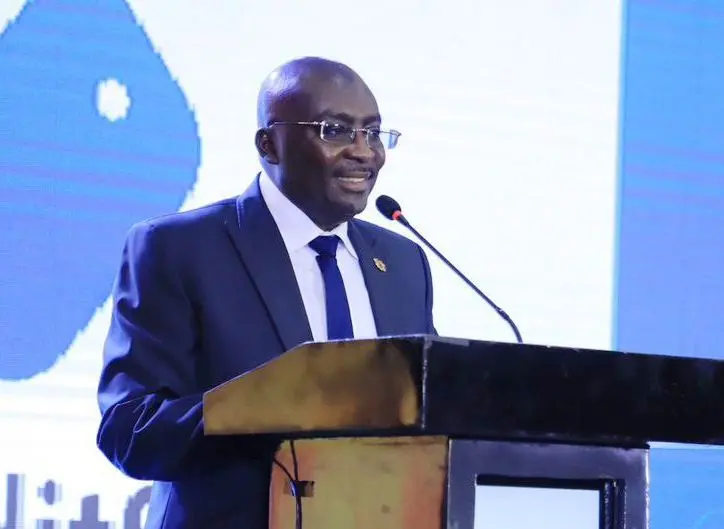
Africa's moment in the global artificial intelligence revolution may hinge not on the ambitions of individual nations, but on whether the continent can summon the collective will to cooperate across borders. That was the central argument advanced by former Vice President Dr Mahamudu Bawumia at the London School of Economics Africa Summit 2026, where he delivered a keynote address that touched on digital sovereignty, continental infrastructure, and Africa's future as a co-creator -- not merely a consumer -- of the world's emerging AI economy.
The Case for Continental Cooperation
Dr Bawumia, who also holds the mantle of the New Patriotic Party's flagbearer for the 2028 general election, used the prestigious platform to issue a clear-eyed challenge to the prevailing model of fragmented, nation-by-nation approaches to technology adoption. He argued that while individual African governments have made commendable strides in developing national digital strategies, those gains will remain modest in the absence of meaningful cross-border integration.
"Artificial intelligence can unite borders if Africa builds capability and then connects that capability across borders," Dr Bawumia told the summit audience. "If we treat AI as a national and continental capability stack, we can become co-authors of the rules, the markets, and the benefits."
His remarks come at a pivotal juncture for the continent. Several African nations, including Ghana, Kenya, Nigeria, Rwanda and South Africa, have rolled out national AI strategies or digital transformation roadmaps in recent years. Yet critics have long warned that these parallel efforts risk duplicating costs, creating incompatible standards, and ultimately leaving African countries as price-takers in a global technology market shaped by decisions made in Washington, Beijing, and Brussels.
Shared Infrastructure as a Foundation
Central to Dr Bawumia's vision was the need for what he described as shared digital infrastructure -- the physical and regulatory scaffolding that would allow data, talent, and AI applications to move freely and securely across African borders.
He called specifically for the development of regional cloud computing systems that serve multiple African countries, reducing dependence on hyperscale cloud providers based in North America, Europe, and East Asia. He also stressed the need for harmonised data governance frameworks that would allow businesses and institutions to share information across frontiers without running into a patchwork of conflicting national regulations.
The former Vice President argued that digital sovereignty -- Africa's ability to control and benefit from its own data and AI systems -- cannot be achieved by any single country acting alone. A Ghana-only cloud, or a Nigeria-only data standard, he implied, would simply be too small to generate the scale, the investment, or the talent pipeline needed to compete globally.
"Build foundations, govern trust, and then connect markets so African talent and AI solutions can scale across the continent," Dr Bawumia stated.
AfCFTA as a Digital Catalyst
Perhaps the most concrete policy anchor in Dr Bawumia's address was his invocation of the African Continental Free Trade Area, known widely as AfCFTA. He pointed to the landmark trade agreement, which entered into force in 2021, as a ready-made institutional framework that could be leveraged to drive digital trade, data interoperability, and technology market integration.
The AfCFTA, which covers all 55 member states of the African Union and represents a combined GDP of over three trillion US dollars, was conceived primarily around goods and services trade. However, its evolving digital trade protocol has opened new possibilities for harmonising e-commerce rules, digital payment systems, and technology licensing across borders.
Dr Bawumia's argument was that Africa need not reinvent the wheel. The political groundwork for continental economic cooperation has already been laid. What is now required, in his framing, is the deliberate extension of that framework into the AI and digital innovation space.
For Ghana specifically, such a position carries both historical weight and strategic logic. The country has in recent years positioned itself as a hub for technology and fintech investment in West Africa, with initiatives like the Ghana.GOV digital services platform and the growth of the Accra tech ecosystem. Embedding those national assets within a larger continental architecture would, proponents argue, amplify their impact considerably.
Africa as Co-Author, Not Bystander
Underlying Dr Bawumia's entire address was a philosophy of agency -- a rejection of the notion that Africa must simply wait to receive the benefits, or absorb the disruptions, of AI systems designed elsewhere.
He made the point explicitly: Africa must position itself as a co-creator in the global knowledge economy. That means more than training local engineers or building digital literacy programmes, though those remain important. It means African institutions must have a seat at the table when international norms around AI safety, data privacy, algorithmic accountability, and intellectual property are being written.
This is not purely aspirational rhetoric. The global AI governance conversation is, in fact, at a formative stage. Bodies like the United Nations, the OECD, the G7, and the G20 are actively working to develop frameworks that will shape how AI is developed, deployed, and regulated for decades to come. African nations, through the African Union, are increasingly seeking to assert a coherent voice in those processes. Dr Bawumia's remarks align with and amplify that push.
- Shared regional cloud infrastructure to reduce reliance on foreign hyperscalers
- Harmonised data governance frameworks enabling cross-border data flows
- Leveraging AfCFTA to power digital trade and technology market integration
- Building continental AI capability stacks, not isolated national silos
- Positioning Africa as a rule-maker in global AI governance forums
Challenges Ahead
The vision Dr Bawumia outlined is compelling, but implementation faces significant headwinds. Connectivity remains deeply uneven across the continent, with large swaths of rural Africa still lacking reliable broadband access. Data centre capacity is concentrated in a handful of cities. Digital literacy gaps persist at scale. And the political will to cede national regulatory autonomy to continental bodies has historically been difficult to sustain.
There are also questions of financing. Building the kind of shared infrastructure Dr Bawumia envisions requires substantial capital -- capital that African governments have typically had to seek from international partners, a dynamic that can itself become a vector for external dependency.
Nevertheless, the argument for cooperation rather than fragmentation is growing harder to resist. The AI transition will reshape labour markets, health systems, education, agriculture, and public administration across Africa, as it will everywhere. Countries that collaborate to shape those changes will be better positioned than those that face them alone.
A Timely Call
Dr Bawumia's address at the LSE Africa Summit arrives at a moment when Ghana, and Africa more broadly, is thinking seriously about the terms on which the continent will engage with the AI revolution. Whether his vision of a unified African capability stack takes root will depend on decisions made not just in Accra or Abuja, but in Addis Ababa at the African Union, in the corridors of AfCFTA secretariat, and in the negotiating rooms of global AI governance institutions.
The former Vice President has issued a clear challenge. The continent's response will be one of the defining stories of the decade ahead.
More from GhanaFront Editorial
Related Stories
More from Technology
Africa Cannot Afford to Miss the Fourth Revolution - Bawumia
Bawumia warns Africa cannot afford to miss the fourth revolution- but what's at stake if the continent falls behind?
1h ago•4 min read

Bawumia calls for cross-border cooperation to unlock Africa's AI potential
Bawumia urges African countries to unite on AI - but can cross-border collaboration truly unlock the continent's potential?
2h ago•2 min read
Africa risks missing another tech revolution without urgent AI adoption - Bawumia
Bawumia says Africa risks missing the tech revolution - what's the solution he proposes?
3h ago•2 min read

AI will reshape jobs but offers opportunity if managed well - Bawumia
AI will significantly transform labor markets- but how can Africa ensure workers transition into roles where AI complements them?
2h ago•2 min read