Africa Must Build and Connect Its Own AI Future, Bawumia Tells LSE Summit

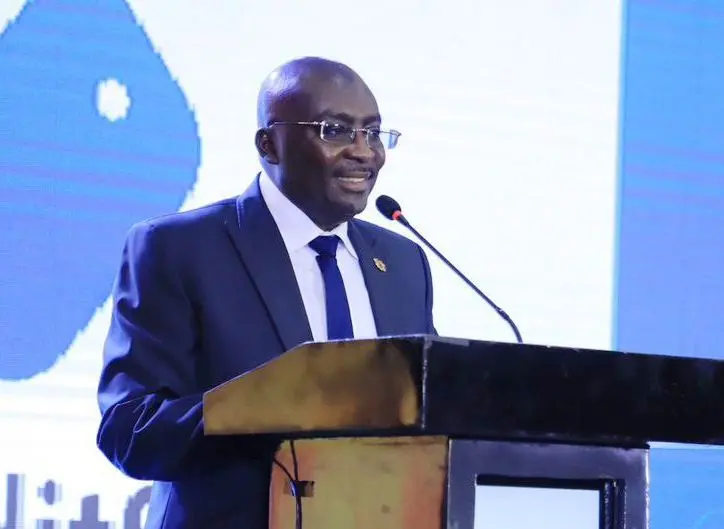
Image: GhanaFront Editorial
Africa Must Build and Connect Its Own AI Future, Bawumia Tells LSE Summit
Former Vice President Dr Mahamudu Bawumia has urged African nations to abandon the habit of treating artificial intelligence as a collection of imported tools, calling instead for a bold continental strategy built on shared infrastructure, harmonised governance, and deep cross-border collaboration.
Speaking at the prestigious London School of Economics Africa Summit 2026, Dr Bawumia -- who is widely regarded as the NPP's most prominent voice on technology policy and is already positioning himself as the party's 2028 flagbearer -- delivered what many observers described as his most comprehensive vision yet for how Africa can secure a meaningful place in the rapidly evolving global AI economy.
A Continent of Co-Creators, Not Consumers
At the heart of Dr Bawumia's address was a pointed critique of the current posture many African governments have adopted towards technology: passive adoption rather than active creation.
"Artificial intelligence can unite borders if Africa builds capability and then connects that capability across borders," he told the audience of policymakers, academics, and development professionals gathered in London. "If we treat AI as a national and continental capability stack, we can become co-authors of the rules, the markets, and the benefits."
It is a distinction that carries significant weight. For decades, African nations have found themselves as end-users of technologies developed elsewhere -- subject to terms, pricing, and priorities set by external actors. Dr Bawumia argued that AI presents a rare and closing window of opportunity to break that cycle, but only if African nations move with coordinated urgency.
"The countries that will shape the rules of the AI economy are the ones building now," he said. "Africa cannot afford to wait until the architecture is set and simply plug in at the margins."
The Case for Shared Digital Infrastructure
Central to Dr Bawumia's vision is the development of shared continental digital infrastructure -- regional cloud systems, interconnected data centres, and common technical standards that would allow AI solutions developed in one African country to function seamlessly across another.
He pointed out that one of the most significant barriers to AI development on the continent is the fragmentation of digital infrastructure. Each country building its own isolated systems not only duplicates cost but also limits the scale needed to make AI applications genuinely competitive with those built in North America, Europe, or East Asia.
Regional cloud infrastructure, he argued, would serve a dual purpose: reducing the cost of AI deployment for governments, startups, and enterprises, while simultaneously diminishing the continent's dependence on hyperscale cloud providers headquartered far from Africa's shores.
"We need to reduce our dependence on external systems and strengthen Africa's digital sovereignty," he emphasised. "That is not protectionism. That is strategic common sense."
Harmonising Regulations to Enable Digital Trade
Beyond infrastructure, Dr Bawumia placed considerable emphasis on the need for harmonised regulatory frameworks -- particularly around data governance, privacy standards, and the rules governing cross-border data flows.
This is not a new challenge for the continent. The patchwork of data protection laws, cybersecurity regulations, and digital trade policies across Africa's 54 nations has long been cited as a barrier to the growth of continental digital commerce. A business in Accra seeking to deploy an AI-driven service in Nairobi, Lagos, or Johannesburg often faces a maze of differing compliance requirements that inflate costs and slow expansion.
Dr Bawumia pointed to the African Continental Free Trade Area (AfCFTA) as a critical framework for addressing this challenge. While AfCFTA is primarily known for its ambitions around goods and services trade, its digital trade protocols -- still under development -- could, if properly designed, provide the legal architecture for seamless cross-border data flows and mutual recognition of digital standards.
"Build foundations, govern trust, and then connect markets so African talent and AI solutions can scale across the continent." -- Dr Mahamudu Bawumia, LSE Africa Summit 2026
He was clear that without trust as a foundation -- trust between governments, trust between businesses, and trust from citizens that their data will be handled responsibly -- no amount of infrastructure investment will yield the desired results.
Why This Matters for Ghana
Dr Bawumia's remarks carry particular resonance in Ghana, where he was instrumental in driving the government's digital transformation agenda during his tenure as Vice President. Under his watch, Ghana launched the Ghana Card national identification system, advanced mobile money interoperability, and pushed for the digitisation of government services -- initiatives that gave the country a relative head start in digital readiness compared to many of its regional peers.
However, critics have noted that while Ghana's domestic digital infrastructure has improved, the country -- like most on the continent -- still relies heavily on external AI tools and platforms for its most sophisticated applications. Local AI development remains nascent, constrained by gaps in training data, computing power, and technical talent.
The vision Dr Bawumia articulated in London would, if pursued seriously, require sustained political will, significant investment, and a level of regional coordination that has historically proved difficult to achieve on the continent.
Uniting Borders as Strategy, Not Slogan
Dr Bawumia was direct in anticipating and dismissing the scepticism such ambitions typically attract. "Uniting borders is not merely a slogan," he stated. "It is a practical strategy."
He outlined what he sees as the three pillars of that strategy:
- Building capability: Investing in AI education, research institutions, and local development ecosystems so that Africa is producing AI talent and solutions, not just importing them.
- Governing trust: Establishing clear, consistent, and rights-respecting regulatory frameworks that give citizens confidence in how AI is deployed and that give businesses the legal certainty to invest.
- Connecting markets: Using frameworks like AfCFTA and regional economic communities to enable African AI products and services to scale across the continent without being fragmented by regulatory barriers.
Taken together, this framework reflects a sophisticated understanding of the layered challenges Africa faces in the AI space -- one that goes well beyond the common talking points about skills training or investment attraction.
A Broader Political Context
Dr Bawumia's appearance at the LSE Africa Summit also carries political significance. Having been defeated in the 2024 general election alongside the NPP, he is in the process of re-establishing his profile and sharpening his policy platform ahead of a potential 2028 presidential run. His continued focus on technology and digital transformation -- the area where he is most differentiated from rivals within both the NPP and the broader political landscape -- signals that this will remain a cornerstone of his public positioning.
For Ghana's broader policy conversation, however, the substance of his remarks deserves serious engagement regardless of the political context in which they are delivered. The questions he raised -- about sovereignty, infrastructure, regulation, and continental coordination -- are ones that will need answers from whichever government is in power.
Africa's window to shape the trajectory of AI, rather than simply adapt to it, is real but not indefinitely open. As Dr Bawumia put it, the goal is for African talent and African-built AI solutions to scale across a connected continent. Whether the political will to pursue that goal can be mobilised in time is a question that goes well beyond any single summit speech.
More from GhanaFront Editorial
Related Stories
More from Technology
Africa Must Unite to Win the AI Race, Bawumia Tells London Summit
Bawumia urges African nations to build shared AI infrastructure and governance frameworks to become co-authors of the gl
14m ago•7 min read
Bawumia Urges Africa to Build a Continental AI Capability Stack, Not Fragmented National Silos
Bawumia calls on African nations to build shared AI infrastructure and regional cloud systems to become co-creators in t
6h ago•6 min read
Africa Cannot Afford to Miss the Fourth Revolution - Bawumia
Bawumia warns Africa cannot afford to miss the fourth revolution- but what's at stake if the continent falls behind?
5h ago•4 min read

Bawumia calls for cross-border cooperation to unlock Africa's AI potential
Bawumia urges African countries to unite on AI - but can cross-border collaboration truly unlock the continent's potential?
6h ago•2 min read