Imperial College Pushes Stronger Science Ties With Africa
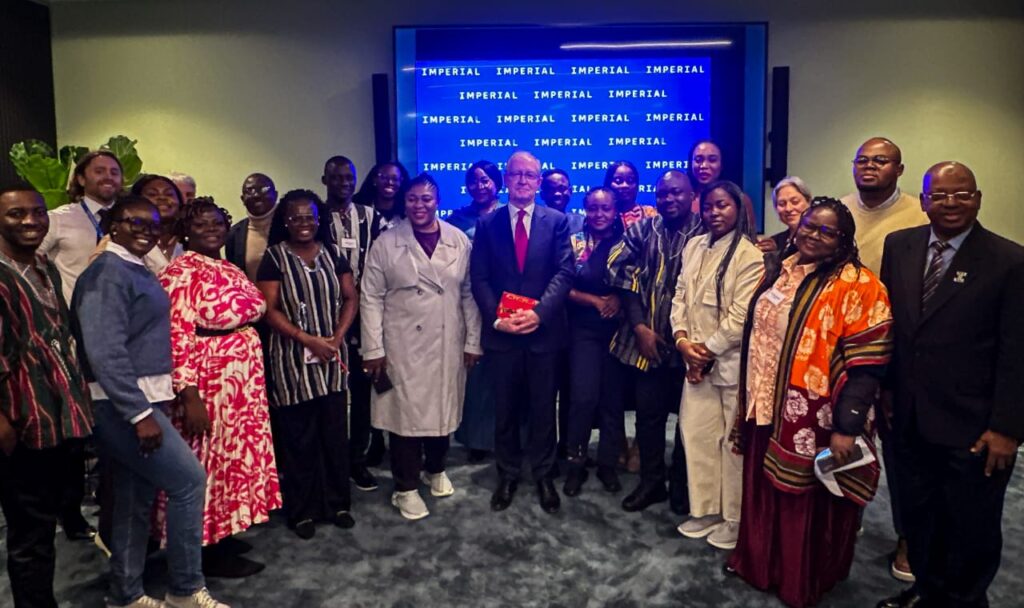
Image: GhanaFront Editorial
Imperial College London is pushing for stronger scientific partnerships with Africa, with its president, Prof. Hugh Brady, arguing that the next phase of global research must be built on collaboration, convergence science and deeper engagement with the continent’s expanding innovation ecosystem.
Speaking during an interaction with selected journalists from Ghana and Nigeria under a Science, Technology and Innovation Journalism Training Programme, Prof. Brady said the most urgent challenges facing the world now demand research models that cut across disciplines and connect institutions across borders.
"The future of research depends on convergence science, international partnerships and stronger links with Africa’s growing innovation ecosystem," Prof. Brady said during the engagement.
His remarks place Africa more firmly within a global science conversation that is increasingly focused on practical solutions, commercialisation and long-term systems impact. For Ghana and other West African countries seeking to strengthen research capacity, attract investment and turn scientific work into jobs and enterprise, that message carries clear significance.
Why collaboration now matters more
Prof. Brady traced his views on research leadership to his early academic experiences, particularly a 1981 student elective at Harvard. He said that period exposed him to a system where clinical care and scientific discovery were tightly connected, allowing ideas to move quickly from laboratory research into medical practice.
That experience, he explained, shaped his understanding of how institutions can create value when they are designed to shorten the distance between discovery and application. The model, often described as "bench-to-bedside", has since become central to his leadership philosophy and remains deeply embedded in the way Imperial approaches innovation.
In practical terms, the argument is that modern universities cannot limit themselves to producing academic papers alone. They must also create conditions for discoveries to improve lives, strengthen industries and support national development priorities. That is especially relevant at a time when countries are being forced to respond to pressure on health systems, climate threats, energy insecurity and economic disruption.
According to Prof. Brady, these are not problems that can be solved by one discipline, one institution or one country acting alone. They require broad, coordinated work involving science, technology, engineering, mathematics, business and public-facing systems that can turn ideas into results.
Imperial’s model and its relevance to Africa
Prof. Brady said Imperial College London defines itself through STEMB -- science, technology, engineering, mathematics and business. He argued that this focus gives the institution a distinct identity and allows it to concentrate on problem-solving in areas with direct social and economic consequences.
He pointed to the university’s founding mission in 1907, saying Imperial was established to be useful. While the meaning of usefulness has evolved over time, he said the institution’s purpose now extends to helping tackle major global issues including climate change, health systems strengthening, energy transition and security.
At the heart of that approach is convergence science, a strategy that brings multiple fields together at scale to address complex challenges. Instead of treating medicine, engineering, data science, business and policy as separate silos, the model encourages joint problem-solving from the start.
For African countries, that idea has practical appeal. Many of the continent’s most pressing issues sit at the intersection of public policy, infrastructure, digital systems, financing and scientific capacity. A digital health solution, for example, may require medical research, software development, telecommunications support, business planning and regulatory cooperation before it can succeed.
That means partnerships with institutions that already work in this integrated way can be valuable, especially when those relationships are structured as mutual exchanges rather than one-way knowledge transfers.
Prof. Brady said Imperial’s international strategy is designed around two-way innovation flows, not a one-sided model of external expertise.
That distinction matters. For years, conversations about African research partnerships have often been shaped by older donor-recipient assumptions. A two-way innovation framework suggests something more balanced: African researchers, entrepreneurs and institutions are not just beneficiaries of global science networks, but active contributors to them.
West Africa hub draws growing attention
One of the clearest signs of that shift, Prof. Brady said, is the work being done through Imperial’s international hubs, including those in Accra, Singapore and San Francisco. These hubs are intended to strengthen global collaboration while anchoring innovation in specific regional ecosystems.
He singled out the West Africa hub as especially impactful, pointing to work in digital health, smart cities, enterprise education and research commercialisation. Those focus areas align closely with sectors where Ghana and the wider region are trying to expand capacity and accelerate economic transformation.
Digital health has become a particularly important area across Africa as governments and private actors look for better ways to improve access, efficiency and data-driven care delivery. Smart city development is also gaining attention as urban centres face increasing pressure on mobility, housing, sanitation, public services and planning systems.
Enterprise education and commercialisation may prove just as critical. Research output alone does not automatically generate jobs, startups or industrial growth. Institutions need systems that help students and researchers understand markets, refine ideas, attract capital and navigate the path from concept to enterprise.
Prof. Brady said students at Imperial and across West Africa are increasingly thinking in global terms while maintaining a strong entrepreneurial orientation. That combination, he suggested, creates fertile ground for partnerships that are not confined to theory, but are also focused on measurable economic impact.
- Digital health collaboration is expanding across institutions and regions.
- Smart cities work is connecting innovation to urban development needs.
- Enterprise education is helping students think beyond the classroom.
- Research commercialisation is gaining importance as a development priority.
For Ghana, this signals opportunity as well as responsibility. Opportunity, because the country is increasingly visible as a serious node within West Africa’s innovation landscape. Responsibility, because turning that visibility into durable outcomes will require investment in local institutions, strong policy alignment and consistent support for research-led enterprise.
The broader message from Prof. Brady’s remarks is that Africa’s role in global science is changing. The continent is no longer viewed only as a site for field research or development intervention. It is increasingly being recognised as a partner in designing, testing and scaling solutions to global problems.
That recognition will mean little without substance. Partnerships must produce real capacity building, stronger institutions, shared ownership of innovation and pathways for young researchers and entrepreneurs to grow. But if structured well, they could help reshape how scientific progress is pursued between Africa and the rest of the world.
For now, Imperial’s stance is clear: the future of science will be collaborative, cross-disciplinary and international. In that future, Africa is not at the edge of the conversation. It is moving closer to the centre.
More from GhanaFront Editorial
Related Stories
More from Technology

Prof Mike Oquaye backs Kojo Bamba's call for stronger ballot protection
Why is a former Speaker backing a call for stronger ballot protection - and what does it mean for Ghana's next election?
1d ago•3 min read