Ghana's Oil Slump Deepens as IES Warns of Revenue Shock
Image: GhanaFront Editorial
Ghana's oil industry is facing one of its most difficult tests since commercial production began, with a new assessment by the Institute for Energy Security pointing to six straight years of falling crude output and a heavy cost to national revenue.
The IES report, authored by Smith Prosper Boahene and Prince Lumor, says production has almost halved since 2019, when Ghana pumped 71.44 million barrels of crude. By 2025, output had dropped to 37.30 million barrels, a fall of nearly 48%. The Energy Commission expects the slide to continue in 2026, with production projected at 34.83 million barrels.
IES says the decline is not a normal market swing, but the result of several structural, operational and policy failures building up over time.
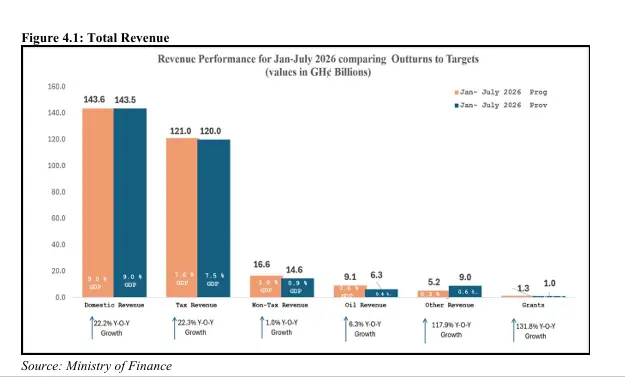
For a country where petroleum receipts support public infrastructure, development programmes and about 10% of total government income, the warning is blunt. Ghana is producing less oil, earning less from the oil it produces, and risking deeper exposure to fuel imports and power-sector pressure if the trend is not reversed.
Revenue losses deepen pressure on the budget
The report says the fall in production has already hit the public purse. Total petroleum receipts dropped from US$1.36 billion in 2024 to US$770.27 million in 2025, a decline of 43.27%. The drop reflected both weaker production volumes and a lower average realised crude price, which moved from US$86.12 per barrel to US$74.93 per barrel.
The first half of 2025 showed how quickly the impact can feed into government revenue. Crude oil production fell by 26% year-on-year to 18.42 million barrels, while petroleum receipts declined from US$840 million to US$370 million.
IES estimates that Ghana missed out on more than US$16.5 billion in potential gross oil revenue between 2019 and 2025. Its calculation was based on an illustrative scenario in which the country maintained modest annual production growth of 3% through continued drilling, new petroleum agreements and stronger reservoir management. Under that scenario, cumulative production would have exceeded actual output by about 221 million barrels.
- Production fell from 71.44 million barrels in 2019 to 37.30 million barrels in 2025.
- The Energy Commission projects 34.83 million barrels in 2026.
- Petroleum receipts fell by 43.27% between 2024 and 2025.
- IES estimates more than US$16.5 billion in potential gross oil revenue was lost from 2019 to 2025.
Ageing fields and weak investment pipeline drive the slide
The report identifies three main pressures behind the downturn: natural depletion in mature oil fields, limited replacement reserves, and the absence of new petroleum agreements since 2018. Ghana's production remains heavily dependent on the Jubilee, TEN and Sankofa Gye Nyame offshore fields.
Jubilee remained the country's biggest producing field in 2025, delivering 22.2 million barrels. Yet it also recorded the sharpest year-on-year decline of more than 30%, partly because of a planned shutdown from March 26 to April 8.
IES argues that the brief production improvement seen in 2024 after drilling under the Jubilee South East project shows that targeted investment can slow the fall. The problem, in its view, is that Ghana has not added enough new production capacity to offset the decline of ageing assets.
The report noted that COVID-19 worsened an already-declining trend rather than creating the problem.
The implications stretch beyond export earnings. IES warned that falling crude output could affect domestic gas supplies used for thermal power generation. If local gas availability weakens, Ghana may have to rely more on imported fuels, leaving the economy more exposed to exchange-rate volatility and global energy price shocks.
The Ghana National Petroleum Corporation has also been squeezed. According to the report, revenues to GNPC fell by more than 61%, a situation compounded by a policy decision that reduced the corporation's share of petroleum revenues from 30% to 15%.
IES also referenced findings in the Public Interest and Accountability Committee's 2025 Annual Report, including rising cash-call obligations on the TEN field and US$561.65 million in petroleum revenue linked to GNPC subsidiary Explorco that remains unaccounted for.
Government turns to new drilling and regulatory review
The Ministry of Finance acknowledged the production decline in the 2026 Budget Statement. It noted that average daily oil production had fallen from about 200,000 barrels per day in 2019 to around 150,000 barrels per day in 2025.
Government says it has secured more than US$3.5 billion in investment commitments to reverse the trend. The package includes a US$2 billion framework to drill 20 additional wells in the Jubilee and TEN fields, plus a US$1.5 billion Memorandum of Intent with partners in the Offshore Cape Three Points block.
GNPC is also expected to begin drilling activities in the Voltaian Basin from October 2026. In addition, government is reviewing upstream fiscal and regulatory frameworks as part of efforts to attract fresh investment from international oil companies, including Shell.
Parliament has ratified extensions to Tullow Oil's petroleum agreements covering the West Cape Three Points and Deep Water Tano blocks. The approvals allow operations at Jubilee and TEN to continue until December 31, 2040, and provide for GNPC to raise its stake in the fields by 10% from July 20, 2036.
The administration of President John Dramani Mahama has also announced measures aimed at restoring investor confidence, including the settlement of legacy energy-sector debts and renewed efforts to stimulate upstream petroleum investment.
IES wants government to move faster. It is calling for transparent and competitive licensing rounds, quicker implementation of the planned drilling programme, and tighter oversight by Parliament and PIAC of the US$2 billion investment programme.
The think tank also wants reforms to strengthen GNPC, including action on the outstanding US$561.65 million linked to Explorco and a review of the reduction in GNPC's petroleum revenue allocation.
Other voices are also urging caution and discipline. The Africa Sustainable Energy Centre has warned against plans to invest petroleum funds in domestic gas and power infrastructure, arguing that such a move could weaken the funds' role as a foreign exchange stabilisation tool and worsen Ghana's estimated US$14 billion energy-sector debt. Financial economist Professor Lord Mensah has also linked the petroleum revenue decline to inconsistent fiscal and investment policies, urging government to direct oil proceeds into infrastructure, agriculture and export-led diversification.
For IES, the message is clear: Ghana's oil slump is no longer a temporary production problem. It has become a policy test, an investment test and a revenue-management test. Reversing it will require new licensing, faster investment, stronger operational performance and institutions capable of protecting national value from a shrinking petroleum base.
More from GhanaFront Editorial
Related Stories
More from Business & Economy

Unchecked imports and the Middle East crisis threaten Ghana's fragile food inflation anchor
Could the Middle East crisis unravel Ghana's fragile food inflation anchor and trigger a new economic shock?
1d ago•
![Ablakwa details GH¢49.7m SA evacuation spending, rejects Minority's claims of unaccounted funds [Video]](https://ghanafront.com/storage/images/2026/10/ablakwa-details-ghc497m-sa-evacuation-spending-rejects-minoritys-claims-of-unaccounted-funds-video-91662b9c-card.webp)