Ghana Youth Demand Bigger Stake In Food Systems Investments
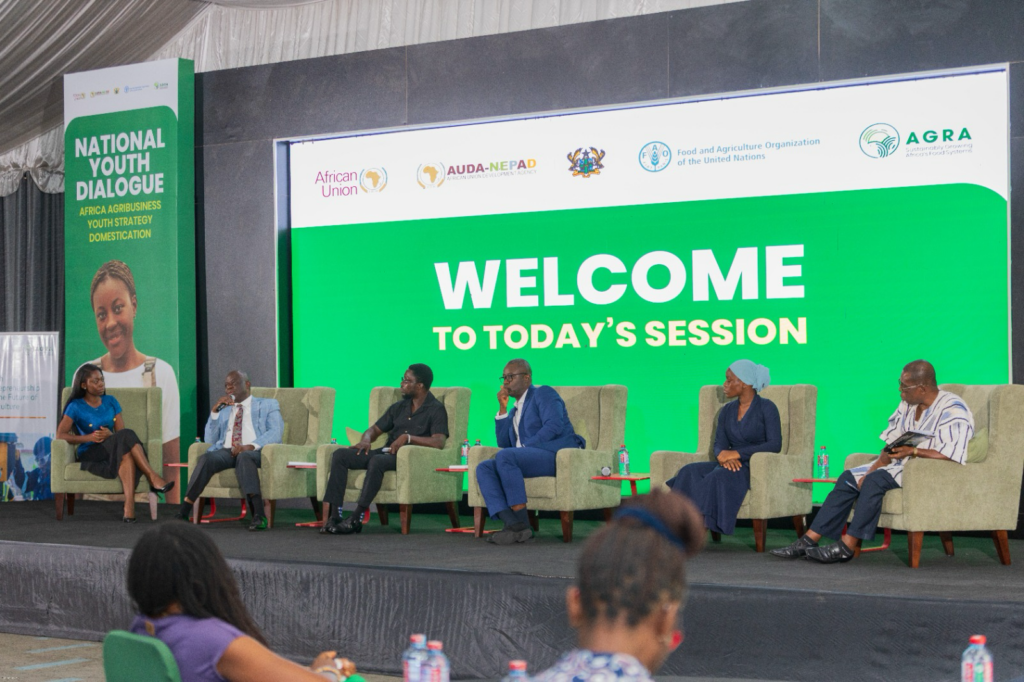
Image: GhanaFront Editorial
Young agribusiness practitioners have pressed Ghana to turn its big food systems promises into funded opportunities for the youth, after a three-day National Youth Dialogue in Accra ended with a demand for clear budgets, targets and reporting lines across major agricultural programmes.
The dialogue focused on how Ghana can domesticate the Africa Agribusiness Youth Strategy and the Youth in Agrifood Systems Performance Index, two African Union frameworks designed to move youth inclusion in agriculture from policy language into measurable delivery. The event was organised by AGRA, the Mastercard Foundation and the Government of Ghana.
More than 350 youth agribusiness practitioners joined representatives from public institutions, parliament, regional trade bodies, private sector organisations, development partners and technical agencies for the engagement. The theme was “Bridging Policy to Practice for Youth Participation in Regional and Continental Markets”.
“The stronger story for Ghana is not that youth are mentioned in policy; it is that Ghana can measure whether young people have skills, assets, jobs, voice and resilience.”
Youth want measurable access to flagship agriculture programmes
At the centre of the youth demand is a call for Ghana to define exactly how young people will benefit from the Feed Ghana Programme, the National Agricultural Investment Program, the National Youth Policy, AfCFTA trade systems and district-level delivery structures.
The youth said Ghana must move beyond symbolic references to young people in agrifood policy. Their position is direct: every youth commitment should show who is responsible, how many young people will benefit, what instrument will be used, how much it will cost, which institution will report it and how progress will be measured.
The Feed Ghana Programme, launched in 2025, is the government’s flagship agricultural initiative to increase domestic food production, reduce the national food import bill and create sustainable jobs. Its planned interventions include 270 farmer service centres, farm banks, agricultural production enclaves, input-credit systems, extension platforms and market infrastructure.
Participants argued that those delivery channels should include specific youth service lanes. These would cover practical support such as skills development, advisory services, finance, land readiness, mechanisation, aggregation, certification and market access.
The employment numbers attached to Ghana’s agrifood plans are significant. The Feed Ghana Programme is expected to create about 2.6 million direct and indirect jobs. The NAIP theory of change projects more than 900,000 direct jobs and 1.7 million indirect jobs by 2029.
For the youth groups, the issue is not only the headline job figure. They want Ghana to define the youth share of those jobs, track whether the work is decent and ensure youth-led enterprises can sell into real markets.
Finance, land and markets dominate the policy demands
The dialogue also examined the size of Ghana’s agrifood investment envelope and how young people can see a direct path into it. Participants cited about GH¢302.21 billion, equivalent to $27 billion, for the Feed Ghana Programme and GH¢322.91 billion, equivalent to $29 billion, for NAIP.
They called for these resources to include youth-visible finance windows rather than leaving young agribusiness operators to compete in broad programmes without defined access points.
- Ring-fenced youth access to farm banks, irrigation and mechanisation services.
- Youth-disaggregated reporting on inputs, advisory services, energy and productive infrastructure.
- Contract farming legislation to protect producers and buyers.
- Tax exemptions for youth-led agro-processing enterprises.
- Youth land banks and stronger links to certification, standards and market access.
Working groups also discussed the modernisation of technical and vocational training, with participants calling for a Youth Agrifood Skills and Mentorship Track. The proposed track would run through farmer service centres, vocational institutions, universities, National Service, innovation hubs and private agritech mentors.
Climate-smart agriculture was another priority. Participants said targets on insurance, warehousing, aggregation, import substitution, child stunting reduction and climate-smart practices should be connected to youth-led climate-smart enterprises. That link, they argued, would make youth inclusion part of Ghana’s food security strategy rather than a separate social intervention.
“Every youth commitment should state who, how many, through which instrument, at what cost, by which institution and how it will be reported.”
Parliament urged to back reforms and track delivery
The sessions ended with a Youth-Parliamentary Dialogue involving members of Ghana’s Parliament. The youth called on government to integrate the Africa Agribusiness Youth Strategy and the Youth in Agrifood Systems Performance Index into the Feed Ghana Programme, NAIP, National Youth Policy implementation and relevant trade and enterprise programmes.
They also demanded formal youth representation in policy design, planning, budgeting, sector review, district delivery and accountability mechanisms. Their appeal to parliament and other stakeholders covered reforms in finance, land, certification, standards, contract farming, tax incentives and market access.
“Youth intentionality should not be treated as a side note in Ghana’s agrifood agenda. It should be embedded in the FGP’s delivery machinery, NAIP costing and annual action plans.”
Chairman of Parliament’s Food and Agricultural Committee, Dr Godfred Seidu Jasaw, welcomed the proposals and said parliament would study the commitments from the youth.
“We have accepted these commitments from the youth. They have practical asks that policy would need to address. So, we look forward to working with these commitments, studying them, and fashioning out next steps. This is good. We are excited about the strategy.”
Country Program Lead for AGRA Ghana, Dr John Jagwe, said the dialogue showed why young people need direct platforms to engage policymakers on the decisions that will shape their future. He said the engagement demonstrated that the next generation of agri-leaders is ready to drive the transformation of Africa’s agrifood systems.
Robben Asare, the 2025 National Best Youth Farmer, also described the engagement with members of parliament as a valuable opportunity to share ideas.
The next steps include the preparation of a youth agribusiness parliamentary brief for Ghana’s parliament. The brief will cover finance, tax relief, contract farming, standards, certification and budget markers. The youth will also convene a six-month accountability session and publish Ghana’s first youth agrifood scorecard.
The message from the Accra dialogue is clear. Ghana’s youth are not asking to be praised as the future of agriculture. They are asking to be counted, financed, represented and measured in the programmes already carrying the country’s food systems ambitions.
More from GhanaFront Editorial
Related Stories
More from Business & Economy

Government procures over 2,000 transformers as Ghana's electricity access hits 89.13% - Energy Minister
Ghana's power grid gets a major boost, but a recent switchyard fire reveals hidden vulnerabilities.
1d ago•