OSP row deepens as NDC voice attacks Akufo-Addo legacy

Image: GhanaFront Editorial
Fresh political criticism has been directed at the Office of the Special Prosecutor after an NDC communications team member argued that the institution was born from political resentment and has since added confusion to Ghana’s prosecution system instead of strengthening accountability.
Speaking on Adom FM’s Dwaso Nsem on April 17, Gifty Enam Gbedevi said the constitutional structure is clear on who holds prosecutorial authority in Ghana. She pointed to Article 88 of the 1992 Constitution and maintained that the Attorney-General remains the central figure in all prosecutions, while agencies such as the police only perform limited investigative roles within the wider justice framework.
Her intervention adds heat to an already active national argument over whether the Office of the Special Prosecutor is fulfilling the mission for which it was established or whether it has instead created institutional overlap that weakens the fight against corruption.
Political motive claim reignites OSP debate
Gbedevi’s sharpest claim was that the office was not created solely as a reform measure, but in a politically charged atmosphere during the administration of former President Nana Akufo-Addo and former Vice President Dr Mahamudu Bawumia. In her telling, the OSP emerged from bitterness and was shaped by a desire to pursue selective action.
“The office was created out of bitterness to facilitate targeted arrests and prosecution. So now, the reason for the High Court to strip the OSP of its power is due to the delayed investigations and prosecution,” she stated.
That remark goes to the heart of a long-running public dispute over the independence, speed and legal reach of the anti-corruption body. Critics of the office have repeatedly questioned whether it has matched its public profile with enough completed prosecutions and concrete outcomes. Supporters, on the other hand, have argued that anti-corruption work is slow by nature and demands insulation from political interference.
Gbedevi’s comments suggest that for some political actors, the issue is no longer just performance. It is also about the original intent behind the institution and whether its structure fits Ghana’s constitutional order.
Constitutional authority and institutional overlap
At the centre of her argument is the claim that prosecutorial authority under Ghana’s Constitution remains firmly with the Attorney-General. She said the creation of a separate office with prosecutorial ambitions has made the legal chain less coherent, especially when matters move between institutions.
According to her, the practical effect has been uncertainty over who should lead corruption-related prosecutions and how such cases should be advanced once investigations are complete. She argued that this movement of dockets between the Attorney-General’s Department and the OSP has created avoidable complications.
“In all, the Attorney-General is the sole person who can handle prosecution. The OSP arrangement creates confusion when dockets move back and forth,” she said.
This concern reflects a broader legal and institutional conversation that has grown louder in recent years. Ghana’s anti-corruption architecture includes several bodies with oversight, investigative or prosecutorial roles, but the question of final prosecutorial control remains politically sensitive and legally important. When agencies appear to compete, the public can lose confidence in the system’s coherence.
For critics like Gbedevi, the problem is not merely duplication. It is the possibility that parallel structures consume resources, delay action and blur accountability. If the public cannot tell which office is responsible for moving corruption cases forward, then blame becomes easy to shift and reform becomes harder to measure.
- She cited Article 88 as the constitutional anchor for prosecutions in Ghana.
- She said the police and similar bodies may investigate, but do not replace the Attorney-General’s authority.
- She argued that docket transfers between offices have deepened confusion.
- She linked recent legal scrutiny of the OSP to delays in investigations and prosecution.
Value for money and calls for a return to older structures
Gbedevi also focused on what she described as the weak output of the OSP relative to the public resources committed to it. In her view, the office has not delivered results that justify its current existence as a stand-alone institution. That criticism is especially potent in Ghana’s present economic and governance climate, where spending on public institutions is under closer public examination.
She argued that Ghana had pursued prosecutions of high-profile public officials before the OSP was established and questioned why an improved version of earlier prosecutorial arrangements could not do the same work more efficiently. Her reference point was the Directorate of Public Prosecutions model, which she suggested could be strengthened instead of maintaining a separate anti-corruption office with overlapping functions.
“Look at the sum of money that goes into the OSP’s office, yet there are no results. Those days when we prosecuted Victor Selormey, Kwame Peprah, and the rest, there was no OSP, so why don’t we go back to our Directorate of Public Prosecutions, which existed at a time?”
That argument taps into a practical question many Ghanaians continue to ask about governance reform: should the state build new institutions to solve old problems, or should it fix and fund the structures it already has? For those who share Gbedevi’s position, the OSP may look less like a solution and more like an expensive layer added to an already crowded justice system.
Her comments arrive at a time when legal and political tensions between the Attorney-General’s Department and the Special Prosecutor’s office have again drawn public attention. The central issue remains straightforward, even if the law is contested in detail: who ultimately controls corruption prosecutions in Ghana, and which institutional model is most likely to deliver timely and credible justice?
That debate is not likely to fade soon. Anti-corruption remains one of the most emotionally charged issues in Ghanaian public life, and every dispute over authority, speed or outcomes feeds wider concerns about governance, fairness and public trust. If institutions set up to fight corruption are themselves locked in disputes over power, the credibility cost can be severe.
Gbedevi has now placed herself firmly on one side of that national argument. Her position is blunt: Ghana’s prosecution system should be constitutionally clear, financially defensible and visibly effective. In her assessment, the OSP has not met that standard.
Whether that view gains wider traction will depend on how the ongoing legal and policy disputes unfold. But her intervention has reinforced a point that cannot be ignored: the public wants anti-corruption institutions that do not just signal action, but deliver it quickly, clearly and within the law.
More from GhanaFront Editorial
Related Stories
More from Technology
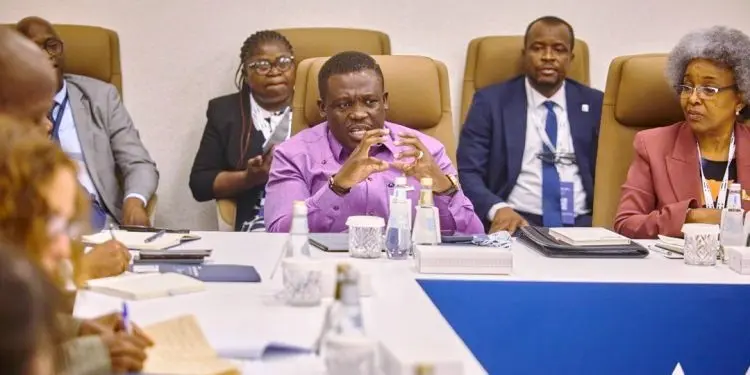
Sam George calls for African approach to AI development and governance
Why is Ghana's minister pushing back on global AI standards at a UNESCO forum?
2d ago•4 min read