Ghana’s Teacher Imbalance Leaves Rural Classrooms Behind
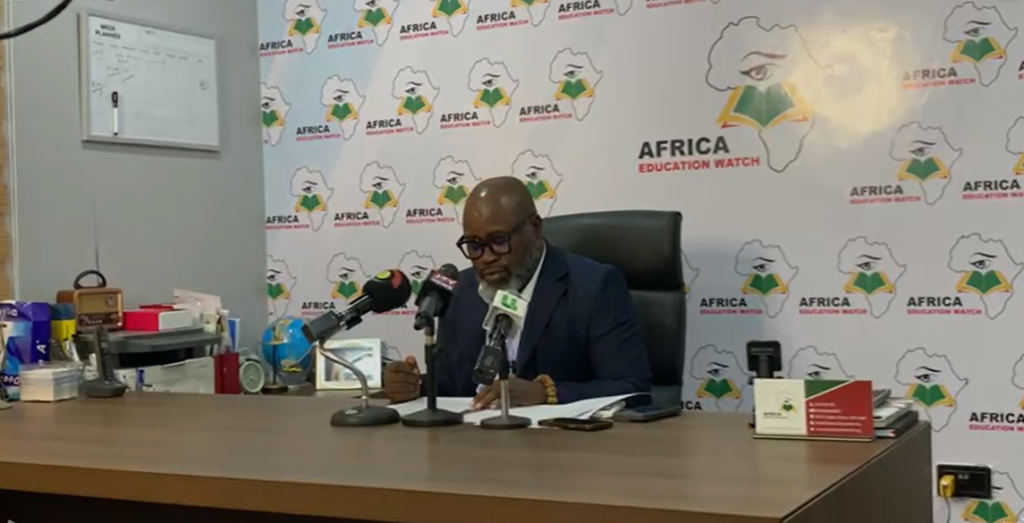
Image: GhanaFront Editorial
Ghana’s school staffing problem is not simply about hiring more teachers. A new warning from Africa Education Watch points to a deeper fault line in the education system: teachers exist in the national workforce, but too many of them are concentrated in the wrong places.
At a press briefing, the policy think tank said the country’s deployment system is leaving many rural schools without the personnel needed to deliver basic education effectively, even while national figures suggest Ghana has more teachers than required at the primary level.
The group’s Executive Director, Kofi Asare, argued that the imbalance is now too stark to ignore. In his assessment, the issue is no longer only about recruitment. It is about how available teachers are allocated across districts, especially between urban centres and hard-to-reach communities.
“Ghana has about 15,000 more teachers than needed to meet the teacher-to-pupil ratio at the primary level.”
That headline figure suggests room for confidence on paper. But the reality inside many classrooms tells a different story. Africa Education Watch says about 30,000 classrooms still do not have teachers because of what it describes as distributive inefficiencies. The result is a system where some areas carry excess staffing while others struggle to keep even the most basic teaching structure in place.
Rural schools continue to absorb the heaviest strain
The concern is sharpest in rural Ghana, where underserved schools often operate with minimal staff while better served urban districts maintain stronger teacher coverage. According to Mr Asare, regional capitals, metropolitan areas and urban municipalities are absorbing surplus deployments that should instead help stabilise teaching in deprived areas.
That gap has direct consequences for pupils. In communities where staffing is thin, one teacher may be forced to handle multiple responsibilities, multiple classes, or an entire school structure that should ordinarily be shared across several trained professionals. This weakens supervision, reduces contact hours, and places enormous pressure on both staff and learners.
Africa Education Watch says some districts illustrate the problem in brutal terms. In those locations, roughly one in five primary schools is reportedly being run by a single teacher. That is not a temporary inconvenience. It is a structural barrier to quality education.
In some districts, about 20 per cent of primary schools are being run by just one teacher.
When a school depends on one teacher to keep operations alive, learning outcomes are bound to suffer. Pupils may receive less individual attention, lesson delivery becomes irregular, and school leadership itself is stretched. In a country committed to improving access and raising educational standards, that reality exposes a gap between policy ambition and day-to-day conditions on the ground.
Primary surplus does not erase deeper shortages
The think tank also stressed that the national picture is not uniform across all levels of education. While primary education may show a surplus in terms of teacher-to-pupil ratios, the situation changes at junior high school. There, shortages remain a serious issue, particularly in STEM subjects.
That distinction matters. It means Ghana’s staffing challenge cannot be solved by relying on a single national average. A headline surplus at one level does not cancel out shortages elsewhere, nor does it help a rural school that cannot access trained staff. Distribution, subject specialization and school location all matter.
For policymakers, the message is clear: education planning must move beyond broad national counts and focus more aggressively on placement efficiency. Without that, the system risks preserving inequity while appearing balanced in official totals.
- Ghana has an estimated surplus of about 15,000 primary-level teachers based on teacher-to-pupil ratios.
- About 30,000 classrooms still lack teachers because of deployment inefficiencies.
- Some districts reportedly have primary schools operated by just one teacher.
- Junior high schools continue to face shortages, especially in STEM subjects.
Policy reform now looks less optional and more urgent
Africa Education Watch says these findings should shape the next round of education reforms. The organisation is calling for deliberate policy action to ensure teachers are deployed more equitably, with stronger attention to rural and underserved districts.
The warning lands at a time when debates over teacher shortages, education quality and access to basic schooling remain active in Ghana. Government efforts to expand educational opportunity will keep running into limits if staffing inequities are left untouched. A classroom can be built, a school can be opened, and enrolment can rise, but if the right teachers do not reach the right communities, the promise of access quickly becomes incomplete.
Equity in education is not only about whether children are enrolled. It is also about whether they are taught by enough qualified teachers in conditions that support real learning. On that measure, the deployment system appears to be failing too many communities.
The challenge now is whether officials will treat the imbalance as a logistics issue that can be managed, or as a central education emergency that demands sustained reform. Africa Education Watch’s argument leaves little room for delay. Ghana already has teachers in the system. The pressing question is why so many classrooms, particularly in rural areas, still wait for them.
- Review district-by-district staffing disparities rather than relying only on national averages.
- Prioritise underserved rural schools in deployment decisions.
- Address subject-specific shortfalls at the junior high level, especially in STEM.
- Align staffing reforms with wider efforts to improve learning outcomes nationwide.
If those reforms are pursued seriously, the country could convert an apparent workforce contradiction into a practical solution. If they are delayed, the burden will continue to fall on children in rural communities who already face the steepest odds in the education system.
More from GhanaFront Editorial
Related Stories
More from Education

GES to distribute EduPack packages to SHS, SHTS
Will EduPack lighten students' load and solve the bedbug problem? See what GES has planned.
1d ago•2 min read

![2026 NSMQ: Jubilation, chants fill auditorium as grand finale kicks off [Video]](https://ghanafront.com/storage/images/2026/09/2026-nsmq-jubilation-chants-fill-auditorium-as-grand-finale-kicks-off-video-93a5db74-card.webp)