Ghana Tightens Counter-Terrorism Strategy as Regional Threats Rise
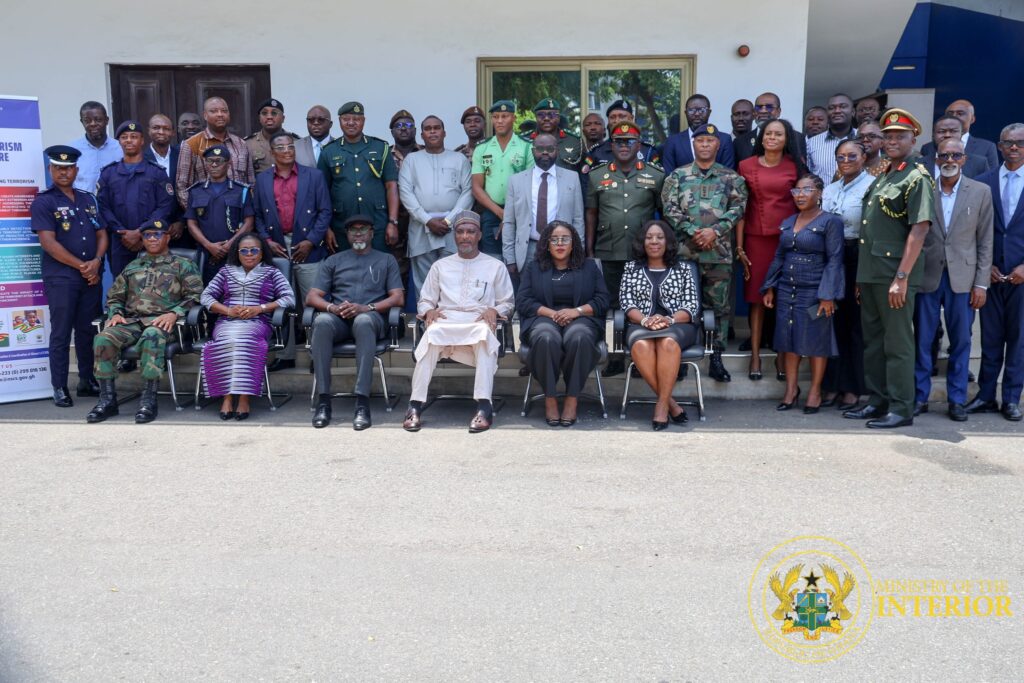
Image: GhanaFront Editorial
Ghana is tightening its counter-terrorism posture as officials warn that instability across parts of West Africa demands faster intelligence use, stronger institutional coordination and sharper border protection.
That message dominated a National Counter-Terrorism Stakeholders Meeting held at the National Security Council Secretariat in Accra, where Interior Minister Muntaka Mohammed-Mubarak called for a more disciplined and intelligence-driven national response to emerging threats.
The meeting brought together security and policy stakeholders under the theme “Strengthening Counter-Terrorism through Reliable Databases and Effective Information Sharing”, with discussions focused on how Ghana can improve preparedness as extremist activity in the sub-region remains a growing concern.
“Information should be passed on timeously so that it is promptly processed into intelligence to help in decision-making to save lives,” the Interior Minister said.
Security planners push faster intelligence and coordinated action
At the centre of the discussions was a warning that terrorism cannot be confronted effectively through isolated institutional efforts. Officials at the meeting stressed that information must move quickly between agencies and be converted into usable intelligence before threats escalate.
For the Interior Minister, the issue is not only the existence of information, but whether it reaches the right desks early enough to shape operational decisions. In practical terms, that means reliable databases, timely reporting, stronger data handling and a system in which warning signs are neither delayed nor ignored.
His remarks reflected a broader concern within Ghana’s security architecture that the country cannot afford to wait for a direct attack before upgrading its response systems. Violent extremist movements operating within the wider West African space have increased pressure on states to strengthen anticipation, prevention and coordinated intervention.
Although Ghana has largely maintained peace and internal stability, officials say that record should not breed comfort. The concern raised at the Accra meeting was clear: relative calm is not permanent protection. It must be defended through vigilance, planning and constant improvement in security coordination.
The meeting therefore served as both an assessment platform and a signal of urgency. Stakeholders examined how the changing nature of terrorism requires more flexible and integrated responses, especially when threats can cross borders, exploit weak information systems and target civilian spaces with little warning.
National strategy to target organised crime and terrorism
The Interior Minister disclosed that the Ministry of the Interior is developing a comprehensive national strategy aimed at confronting both organised crime and terrorism. The approach, as outlined at the meeting, is expected to place intelligence at the core of operations while also reinforcing collaboration among institutions responsible for national security.
The strategy will also pay attention to border security, a critical issue as regional instability continues to shape risk calculations across neighbouring states. Border systems remain one of the most important front lines in preventing infiltration, intercepting suspicious movement and detecting patterns that may point to organised criminal or extremist activity.
Officials say the emerging framework is intended to move Ghana’s response beyond fragmented interventions and into a more structured national posture. That includes improving the ways agencies collect, share and analyse information, while ensuring operational decisions are grounded in credible and timely intelligence.
The emphasis on organised crime alongside terrorism is also significant. In many security environments, the two threats are not treated as completely separate. Criminal networks can create openings that extremist groups exploit, whether through smuggling routes, document fraud, illicit financing or other forms of cross-border activity. A strategy that links the two challenges reflects an effort to deal with the broader ecosystem of insecurity rather than only its most visible symptoms.
Mr. Mohammed-Mubarak also urged institutions to avoid rivalry and focus on national interest. His appeal pointed to a recurring issue in security coordination, where overlapping mandates, information silos or competition for relevance can weaken the overall response. In counter-terrorism work, even small failures in cooperation can carry serious consequences.
- Intelligence-driven operations are expected to be a priority.
- Inter-agency collaboration is being positioned as a central requirement.
- Border security reinforcement is part of the planned national response.
- Reliable databases and effective information sharing remain major focus areas.
Whole-of-society response seen as essential
National Security Coordinator Osman Abdul-Razak reinforced the call for collective action, describing the sub-region as increasingly vulnerable and stressing that terrorism cannot be confronted by government institutions alone.
His intervention broadened the conversation beyond state security agencies to include communities and wider society. According to him, preventing violent extremism requires a whole-of-society approach built on vigilance, coordination and shared responsibility.
That position reflects an established lesson in counter-terrorism policy: early warning often begins outside formal command structures. Communities, local leaders and frontline institutions may detect unusual behaviour or emerging tensions before they appear in official threat assessments. Where those observations are trusted, reported and properly analysed, they can strengthen national prevention efforts.
In that context, the emphasis on effective information sharing is not merely a technical issue. It is also about confidence between institutions and the public, and about whether systems exist to convert scattered reports into actionable intelligence.
The Accra meeting therefore highlighted a layered model of preparedness. At the top level, national institutions must coordinate and deploy intelligence effectively. At the operational level, agencies must work without delay or duplication. At the social level, communities must remain alert and understand that preventing violent extremism is a shared task.
Ghana’s security agencies were commended for helping maintain relative peace, but the consistent message from the meeting was that peace must be actively protected. As extremist violence edges closer in parts of the region, officials want Ghana to remain ahead of the threat through planning, preparedness and stronger cooperation.
The stakeholder meeting forms part of broader national efforts to improve resilience against evolving security risks. The challenge now is to translate the calls made in Accra into durable systems that can identify threats early, improve institutional response and preserve public safety.
For Ghana, the policy direction is becoming clearer: reliable data, timely intelligence, deeper agency cooperation and alert communities will be essential if the country is to maintain stability in an increasingly fragile regional security environment.
More from GhanaFront Editorial
Related Stories
More from Technology

150 women empowered with digital skills under African Girls Can Code Initiative, GIFEC targets 500 next year
Why are 150 women from three regions now equipped to transform their businesses and careers?
1d ago•