Gbintiri Residents Demand Fairness as 24-Hour Market Project Bypasses Ghana's Busiest Trading Hub
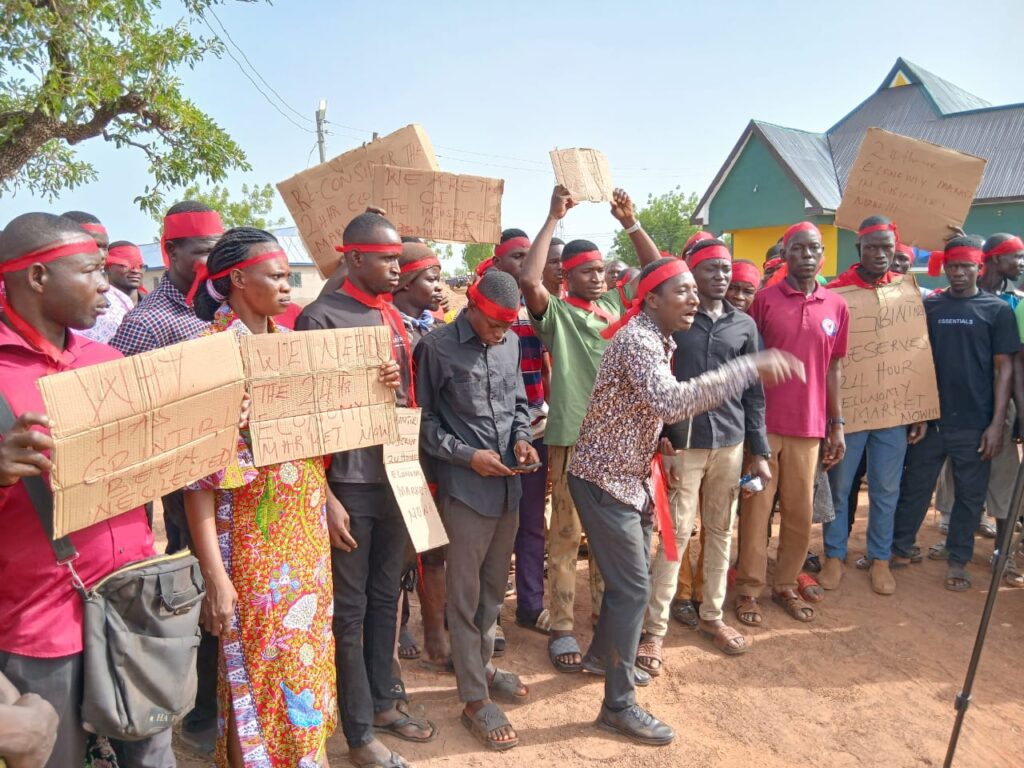
Image: GhanaFront Editorial
Anger is simmering in the East Mamprusi Municipality of Ghana's North East Region, where residents of Gbintiri have taken to the streets over what they describe as a calculated and politically-motivated diversion of a 24-hour economy market project from their community. The protest, which drew a broad coalition of residents, youth groups, traditional leaders, and civil society organisations, has placed two senior government officials squarely in the crosshairs of public outrage.
At the heart of the controversy are the North East Regional Minister, Tia Ibrahim, and the East Mamprusi Municipal Chief Executive, Barichi David Bukari -- both of whom, protesters allege, have leveraged their official positions to steer the infrastructure investment away from Gbintiri and toward their respective home communities of Langbinsi and Sakogu.
A Community Left Out in the Cold
Gbintiri has long served as the commercial backbone of the East Mamprusi Municipality. The town is widely recognised as the area's most active trading hub -- a place where commerce does not stop when the sun goes down. It was precisely this attribute, residents argue, that made Gbintiri the natural and logical site for a 24-hour economy market under the government's flagship economic policy.
The 24-hour economy initiative, championed by President John Dramani Mahama's administration, is designed to extend productive economic activity beyond conventional business hours -- stimulating trade, creating employment, and driving productivity across the country. For communities like Gbintiri, which already operate with near-round-the-clock market activity, such a project would have been a transformative boost.
Instead, residents say, they have been bypassed entirely -- while two separate 24-hour market facilities have been earmarked for other communities within the same municipality.
"Gbintiri is already a thriving commercial centre operating almost around the clock. Moving this project elsewhere raises serious questions about the intent behind the decision."
-- A protest leader in Gbintiri
Protesters Hit the Streets
On Friday, the community's frustration boiled over into public action. Protesters -- comprising a cross-section of residents, youth associations, traditional authorities, and civil society representatives -- marched through the town demanding immediate government intervention and a reversal of what they characterised as an unjust and indefensible decision.
The demonstration was passionate but peaceful. Speakers addressed the crowd with pointed criticism of the officials accused of orchestrating the project's relocation. Many invoked the principles of fairness, transparency, and sound governance -- principles they insist have been abandoned in this instance.
Demonstrators argued that redirecting the market project to Langbinsi and Sakogu -- communities that do not match Gbintiri's commercial footprint -- is not only logically flawed but represents a misuse of public resources for personal and political gain.
Accusations of Political Favouritism
The allegations against the Regional Minister and the Municipal Chief Executive are specific and pointed. Protesters contend that the decision to site the market projects in Langbinsi and Sakogu -- the home communities of Tia Ibrahim and Barichi David Bukari respectively -- is too convenient to be coincidental.
Community representatives say the pattern fits a broader culture of political patronage in which public infrastructure follows officials' personal loyalties rather than objective need or merit. They warn that such practices, if left unchecked, will deepen distrust between citizens and government.
"Those promises are being betrayed. What we are witnessing now undermines public trust."
-- A community representative at the Gbintiri protest
The community also drew attention to the curious decision to allocate two separate 24-hour market facilities within the East Mamprusi Municipality while completely excluding Gbintiri -- the very community that would have yielded the highest economic return and greatest utilisation of such an investment.
Betrayal of Campaign Promises
The frustration in Gbintiri is compounded by the memory of campaign promises made during the lead-up to the 2024 general elections. Residents recall with clarity the pledges made by national leaders -- including President Mahama -- of inclusive governance, equitable development, and government that works for all communities, not just those with politically connected officials.
For many in Gbintiri, the alleged diversion of the market project is a stark and early test of whether those promises carry weight. The community's verdict, at least for now, is that they do not.
"This is not a threat; it is a call for fairness," one protester declared during the march. "If ignored, we will pursue all lawful means to ensure our voices are heard."
Key Demands from Protesters
The protest leaders presented a clear set of demands to the authorities, calling for:
- An immediate review and reconsideration of the decision to relocate the 24-hour market project away from Gbintiri
- Full public disclosure of the criteria and processes used in selecting project sites across the municipality
- Publication of any feasibility studies conducted in relation to the market siting decisions
- Inclusive stakeholder consultations involving Gbintiri residents, traditional leaders, and community organisations before any final determinations are made
The group has also signalled that the current protest is only the beginning. They have vowed to sustain peaceful demonstrations and escalate through all lawful channels should their demands go unanswered.
The Broader Stakes
Beyond the immediate grievance, the situation in Gbintiri points to a persistent challenge in Ghana's development landscape -- the uneven distribution of public resources along political lines, and the erosion of public confidence that follows when communities feel systematically left behind.
The 24-hour economy policy was conceived as a tool for broad-based development. Its credibility, and that of the government implementing it, depends in large part on whether siting decisions are made on the basis of transparent, evidence-driven criteria rather than the geographic preferences of well-placed officials.
For Gbintiri -- a community that has built its own commercial vitality through years of grassroots enterprise -- the stakes could hardly be higher. Residents are not asking for a handout. They are asking for recognition of what already exists and a fair opportunity to benefit from policies their taxes help to fund.
As the community awaits a response from the Regional Minister and the Municipal Chief Executive, the question hanging over the North East Region is a simple but consequential one: will the government listen?
More from GhanaFront Editorial
Related Stories
More from Technology

Beyond word of mouth: Bizella's bid to build trust in Ghana's services market
Can a mobile app replace word-of-mouth for finding reliable plumbers and electricians in Accra?
1d ago•4 min read