Government-Backed Borehole Drive Puts Water Access at Centre of Local Development Agenda

Image: GhanaFront Editorial
Government-Backed Borehole Drive Puts Water Access at the Centre of Local Development Agenda
A nationwide push to expand access to potable water through government-approved borehole projects is quietly reshaping how district and municipal assemblies address one of Ghana's most persistent development challenges. Old Tafo Member of Parliament Vincent Ekow Assafuah has lifted the lid on the initiative, confirming that Municipal Chief Executives (MCEs) and District Chief Executives (DCEs) across the country are sinking boreholes at an average cost of GH₵100,000 per unit -- with the blessing of central government.
Speaking on Oyerepa FM on Monday, the MP drew on his experience as a former Deputy Minister for Local Government and Rural Development to lend credibility to his disclosures, framing the projects not as rogue spending but as a structured, sanctioned programme.
"I can confidently disclose that the Asokwa MCE and other MCEs in the Ashanti Region has been drilling boreholes costing an average of GH₵100,000. Don't forget I have been a Deputy Minister for Local Government and Rural Development before, and I know there has been approval for the MCEs to be drilling these boreholes."
-- Vincent Ekow Assafuah, MP for Old Tafo
What the Numbers Tell Us
The GH₵100,000 average cited by the MP paints a picture of significant investment spread across multiple assemblies. With hundreds of districts and municipalities across Ghana, a wide rollout of such projects could translate into hundreds of millions of cedis in public expenditure directed at water infrastructure alone.
However, Assafuah's figures did not go unchallenged. The Asokwa MCE, who was seated in the same studio during the broadcast, offered a different range for his own municipality -- insisting that borehole projects in Asokwa typically fall between GH₵80,000 and GH₵90,000. That the MCE publicly disagreed with the MP's stated average is itself notable: it signals that while the programme may be centrally authorised, actual costs vary considerably by location, geology, contractor, and the depth required to reach a viable water table.
Such price variation is not unusual in infrastructure work. Drilling in areas with deep rock formations, difficult terrain, or remote locations typically incurs higher costs than projects in more accessible communities. The gap between the MP's GH₵100,000 average and the MCE's GH₵80,000-to-GH₵90,000 range -- while meaningful at scale -- may simply reflect the reality of differing local conditions rather than any fundamental inconsistency in the programme itself.
The Broader Water Access Challenge
Ghana has long struggled with uneven water access, particularly in rural and peri-urban communities. Despite years of investment by successive governments, significant portions of the population still rely on unsafe or distant water sources, with women and children bearing the heaviest burden of water collection.
Boreholes, when properly sited, drilled, and maintained, offer a reliable and relatively cost-effective solution to this problem. Unlike piped water systems, which require extensive distribution infrastructure and ongoing utility management, a functioning borehole with a hand pump or motorised system can serve hundreds of households with minimal recurring cost -- provided maintenance responsibility is clearly assigned.
The acknowledgment that assemblies are rolling out such projects with central government approval suggests a policy environment that, at least for now, prioritises water security as a deliverable at the local governance level. That is welcome news for communities that have waited years, sometimes decades, for reliable water supply.
Questions the Disclosure Raises
While the MP's comments were broadly positive in tone, they also surface a set of questions that Ghanaian citizens and civil society organisations would do well to pursue:
- Procurement processes: How are contractors for these borehole projects selected? Competitive tendering rules exist to protect against inflated pricing and connected-party deals. Are assemblies following those rules?
- Site selection criteria: Which communities are being prioritised, and on what basis? Hydrogeological surveys should ideally guide where boreholes are sunk to ensure long-term viability.
- Functionality rates: Ghana has a troubling track record with boreholes that fall into disrepair within months of commissioning. What maintenance arrangements accompany these new installations?
- Oversight and accountability: Who is auditing the programme? Parliamentary oversight, civil society monitoring, and community water management committees all have a role to play in ensuring value for public money.
These are not merely academic concerns. Studies by WaterAid and other development organisations have repeatedly found that up to a third of rural water points in sub-Saharan Africa are non-functional at any given time -- a staggering waste of public and donor funds. Ghana has been no exception to this pattern.
MCEs and DCEs: Expanding Mandate, Expanding Scrutiny
The disclosure also raises the profile of MCEs and DCEs as development actors in their own right. These appointed officials, who answer to the President rather than directly to voters, have often operated with limited public scrutiny compared to elected MPs. If they are now managing GH₵100,000 infrastructure projects -- with central government authorisation but without necessarily the same level of parliamentary accountability -- the question of oversight becomes more urgent, not less.
Ghana's decentralisation architecture was designed to bring development closer to communities. The flip side of that proximity is the risk that procurement decisions, contractor relationships, and site selection can be influenced by local political considerations rather than need-based criteria. Transparency in how these projects are designed, awarded, and monitored will determine whether the programme delivers lasting value or merely provides another opportunity for leakage.
A Programme Worth Watching
There is genuine cause for optimism in what Assafuah has revealed. A government-backed, assembly-level water infrastructure drive -- if properly managed -- could meaningfully improve quality of life for thousands of Ghanaians who currently lack reliable access to clean water. The ambition is right.
But ambition without accountability has a poor track record in Ghana's infrastructure story. The difference between a programme that transforms communities and one that becomes a footnote in an audit report will hinge on procurement integrity, site selection rigour, community involvement in maintenance, and the willingness of oversight bodies to do their jobs.
As this initiative continues to roll out, media organisations, civil society, and the public interest journalism community have both the right and the responsibility to track where these boreholes are going, how much they are costing, and whether they are actually serving the people they are meant to reach.
For now, the conversation that unfolded on Oyerepa FM -- a sitting MP and an MCE openly disagreeing on costs in real time -- is exactly the kind of frank, fact-based public discourse that water governance in Ghana needs more of. It is a start.
More from GhanaFront Editorial
Related Stories
More from Regional
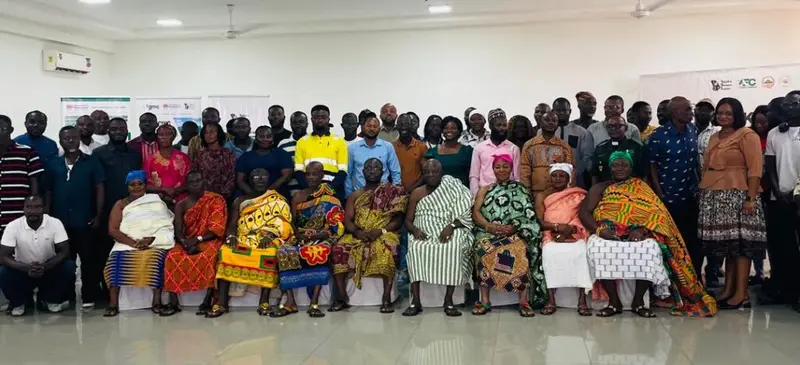
NDF engages Ahafo stakeholders to strengthen fight against illegal mining and protect forests, water bodies
Can Ahafo Region avoid the galamsey crisis devastating other areas? Stakeholders gather to find answers.
3d ago•